Table of Contents
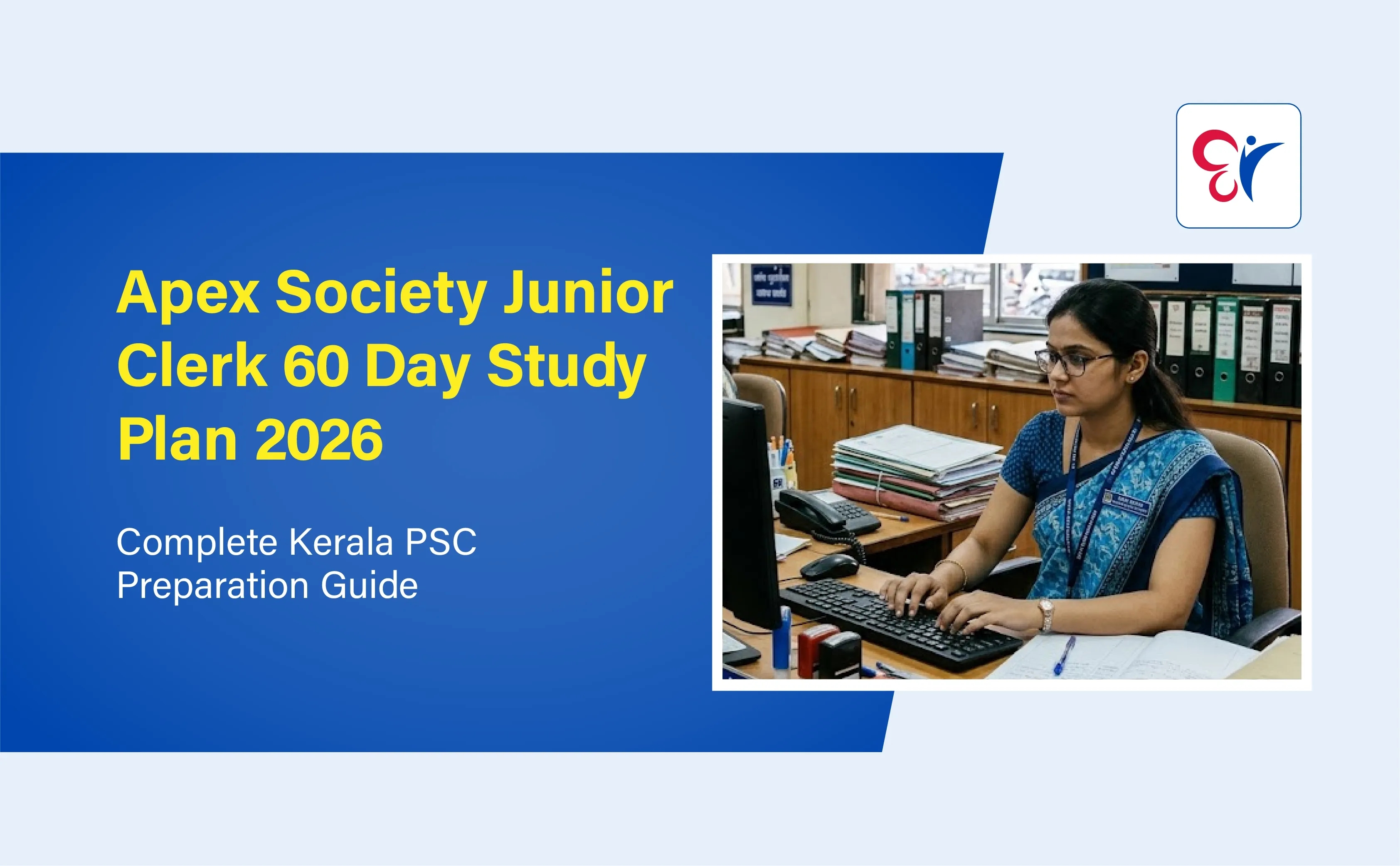
Apex Society Junior Clerk 60 Day Study Plan 2026 can help you cover the syllabus, revise important concepts and practise questions before the examination.
For Apex Society Junior Clerk Category No. 090/2026, the syllabus provided by Kerala PSC is divided into three sections, which are Co-operation (50 marks), Banking (40 marks), and IT & Cyber Laws (10 marks). This means Co-operation and Banking together account for 90 out of the 100 marks, so they should receive the largest share of your study time. However, candidates should not neglect IT and Cyber Laws, as this section can contribute valuable marks.
Scroll down to get a practical 60-day Apex Society Junior Clerk study plan, with a day-wise topic schedule, revision strategy, mock-test guidance and preparation tips based on the prescribed syllabus.
Apex Society Junior Clerk Exam 2026: Overview
Particular | Details |
Exam | Kerala PSC Apex Society Junior Clerk 2027 |
Category Number | 090/2026 |
Recruiting Authority | Kerala Public Service Commission |
Department | Apex Societies of the Co-operative Sector in Kerala |
Total Marks | 100 |
Co-operation | 50 marks |
Banking | 40 marks |
IT & Cyber Laws | 10 marks |
Preparation Period | 60 days |
Study Approach | Topic-wise learning, practice, revision and mock tests |
The Kerala PSC Exam Calendar 2027 lists the exam for Category No. 090/2026 on 27 January 2027. So candidates should advance their Apex Society Junior Clerk Exam preparation based on this 60 day study plan.
Kerala PSC Apex Society Junior Clerk Syllabus and Marks Distribution
Before starting a 60-day study plan, understand how the Kerala PSC Apex Society Junior Clerk Syllabus is organised. The marks assigned to each section provide a useful basis for deciding how much time to spend on it.
Syllabus section | Marks | Share of total marks |
Co-operation | 50 | 50% |
Banking | 40 | 40% |
IT & Cyber Laws | 10 | 10% |
Total | 100 | 100% |
1. Co-operation - 50 Marks
The Co-operation section includes nine major syllabus areas:
- Co-operation and other economic systems
- Evolution and development of co-operative principles
- Types of co-operatives in India and Kerala
- Management and working of major co-operative organisations
- Co-operative audit
- Issues in co-operative management
- Settlement of disputes, arbitration, awards, appeals and penalties
- Sources of funds and state aid to co-operatives
- Co-operative legislation in India and Kerala
2. Banking - 40 Marks
The Banking section contains ten major topics, with four marks assigned to each topic in the supplied syllabus:
- Commercial Banking
- Central Banking
- Indian Commercial Banking - Pre-Liberalisation
- Indian Commercial Banking - Post-Liberalisation
- Banking Legislation in India
- Practices of Banking
- Law Relating to Negotiable Instruments
- Agriculture and Micro Finance by Banks
- Technological Advances in Banking
- Recent Trends in Indian Banking
3. IT & Cyber Laws - 10 Marks
This section covers computer fundamentals and basic digital concepts, including:
- Hardware, input and output devices, and memory devices
- System software, application software and operating systems
- Word processors, spreadsheets, databases, presentation software and image editors
- Basics of programming instructions
- Computer networks and network devices
- Internet services, email, search engines and social media
- Web browsers and basic HTML
- Cybercrimes, the IT Act and other laws at awareness level
Refer to the official Kerala PSC Apex Society Clerk Syllabus 2026 PDF Download to access the complete syllabus.
Apex Society Junior Clerk 60 Day Study Plan 2026
The following Apex Society Junior Clerk 60 Day Study Plan 2026 divides preparation into four stages:
- Days 1-20: Build your subject foundation and cover the first major syllabus areas.
- Days 21-35: Complete the remaining major topics and strengthen understanding.
- Days 36-45: Finish the syllabus, practise questions and address weak areas.
- Days 46-60: Revise, attempt mock tests and improve exam readiness.
The schedule is a recommended preparation framework, not an official Kerala PSC timetable. Adjust the daily workload according to your existing knowledge, available study hours and progress.
Days 1-20: Build a Strong Foundation
The first 20 days focus on understanding the core concepts of Co-operation and Banking. Begin with the basic principles and structures before moving into more detailed organisational, legal and technical topics.
Day | Subject | Topics to Study |
|---|---|---|
Day 1 | Co-operation | Co-operation and other economic systems; capitalism, socialism and communism |
Day 2 | Co-operation | Co-operatives compared with partnerships and joint-stock companies; co-operatives as institutions and enterprises |
Day 3 | Co-operation | Evolution of co-operative principles; Rochdale Pioneers |
Day 4 | Co-operation | ICA reformulated principles, Karve Committee and ICA principles of 1995; values versus principles |
Day 5 | Co-operation | Types of co-operatives in India and Kerala; short- and medium-term credit structures |
Day 6 | Co-operation | Long-term credit structures, agricultural marketing societies and their federations |
Day 7 | Revision | Revise Days 1-6 and attempt a short topic-wise question set |
Day 8 | Co-operation | Dairy, fishery, processing, housing, consumer and industrial co-operatives; workers’ co-operatives |
Day 9 | Co-operation | NAFED, IFFCO, KRIBHCO, NABARD, NDDB, NCDC and National Housing Bank |
Day 10 | Co-operation | Co-operative audit: definition, objectives, scope, advantages and comparison with company audits |
Day 11 | Co-operation | Types and stages of audit, audit programme, reconciliation of bank accounts, auditor’s duties and audit reports |
Day 12 | Co-operation | Co-operative management issues, competition, conflict, organisational size and financing |
Day 13 | Co-operation | Evaluation of co-operatives; member, enterprise and ethical dimensions |
Day 14 | Revision | Revise Co-operation topics covered so far and practise objective questions |
Day 15 | Co-operation | Settlement of disputes, arbitration, awards, appeals, review, revision, tribunal and penalties |
Day 16 | Co-operation | Sources of funds, state aid, share capital, state partnership funds, grants, subsidies and borrowed funds |
Day 17 | Co-operation | Evolution of co-operative legislation in India; Acts of 1904 and 1912; major developments |
Day 18 | Co-operation | Model Co-operative Societies Bills, parallel co-operative laws and Multi-State Co-operative Societies legislation |
Day 19 | Co-operation | Evolution of co-operative legislation in Kerala and the Kerala Co-operative Societies Act, 1969 |
Day 20 | Banking | Commercial banking: origin, banking systems, functions, deposit types and lending methods |
Target by Day 20: Establish a foundation in the major Co-operation topics and begin Banking with a clear understanding of commercial banking.
Days 21-35: Complete Major Banking Topics
Banking accounts for 40 marks, so allocate sufficient time to understand the concepts and practise applying them to objective questions. Use comparison tables, short notes and revision cards for closely related terms.
Day | Subject | Topics to Study |
Day 21 | Banking | Commercial banking: ancillary services, principles of lending, credit creation and its limitations |
Day 22 | Banking | Central banking; origin and nationalisation of RBI; currency issue and RBI’s functions |
Day 23 | Banking | RBI as banker to government and banks; foreign exchange reserves and developmental role |
Day 24 | Banking | Monetary policy: bank rate, open market operations, CRR, SLR and qualitative credit-control methods |
Day 25 | Banking | Pre-liberalisation banking: Imperial Bank, SBI, bank nationalisation and social control |
Day 26 | Banking | Lead Bank Scheme, District Credit Plan, Service Area Approach, DRI Scheme and Regional Rural Banks |
Day 27 | Banking | Post-liberalisation reforms; Narasimham Committees, new-generation banks, mergers and acquisitions |
Day 28 | Banking | Local Area Banks, Payment Banks, Small Finance Banks and financial inclusion initiatives |
Day 29 | Banking | Banking Regulation Act, 1949: objectives, definitions, licensing, inspection, audit and regulation |
Day 30 | Banking | Banking legislation: reserves, dividend restrictions, amalgamation, acquisition and winding up |
Day 31 | Banking | Banker-customer relationship, duties, secrecy of accounts, cheques, garnishee orders and stop payment |
Day 32 | Banking | Banker’s rights, general lien, set-off, appropriation, Ombudsman and types of customers |
Day 33 | Banking | Negotiable instruments: bills of exchange, promissory notes, cheques, drafts and endorsements |
Day 34 | Banking | Crossing and dishonour of cheques, collecting and paying bankers, securities, guarantees and indemnity |
Day 35 | Revision | Revise Banking topics covered so far and practise questions from commercial, central and Indian banking |
Target by Day 35: Complete the main conceptual areas of Banking and identify any topics that need another round of study.
Days 36-45: Finish the Syllabus and Practise IT & Cyber Laws
The next stage completes the remaining Banking topics and covers IT & Cyber Laws. Because the computer section is shorter, it can be studied in focused sessions, followed by regular recall practice.
Day | Subject | Topics to Study |
Day 36 | Banking | Agricultural credit, crop loans, short-, medium- and long-term credit, Kisan Credit Card |
Day 37 | Banking | Priority-sector lending, categories and targets, NABARD’s roles, microfinance and SHG-bank linkage |
Day 38 | Banking | Digital banking, ECS, RTGS, NEFT, IMPS, IFSC, ATM, debit and credit cards, RuPay |
Day 39 | Banking | Internet and mobile banking, digital signatures and certificates, wallets, CDM, CTS, cashless payments and SWIFT |
Day 40 | Banking | CAMELS rating, Tier I and Tier II capital, RWA, CRAR, NPA classification and provisioning |
Day 41 | Banking | Securitisation, SARFAESI Act, PMSBY, PMJJBY and Atal Pension Yojana |
Day 42 | IT & Cyber Laws | Hardware, input and output devices, primary and secondary memory |
Day 43 | IT & Cyber Laws | System and application software, operating systems, word processors, spreadsheets, databases, presentations and image editors |
Day 44 | IT & Cyber Laws | Programming instruction types; LAN, WAN and MAN; media, switch, hub, router, bridge and gateway |
Day 45 | IT & Cyber Laws | Internet services, email, search engines, social media, browsers, basic HTML, cybercrimes, IT Act and other laws |
Target by Day 45: Complete the listed Apex Society Clerk Syllabus areas at least once and begin full-syllabus revision.
Days 46-60: Revision, Mock Tests and Exam Readiness
The final 15 days should focus less on collecting new study material and more on remembering, applying and correcting what you have already studied. Use your mock-test performance to decide which topics deserve additional revision.
Day | Main Focus | Tasks |
Day 46 | Co-operation revision | Revise economic systems, co-operative principles and values |
Day 47 | Co-operation revision | Revise types of co-operatives, credit structures and major organisations |
Day 48 | Co-operation revision | Revise co-operative audit, management issues and sources of funds |
Day 49 | Co-operation revision | Revise disputes, arbitration and co-operative legislation in India and Kerala |
Day 50 | Banking revision | Revise commercial banking, deposits, lending and credit creation |
Day 51 | Banking revision | Revise RBI, monetary policy, pre-liberalisation and post-liberalisation banking |
Day 52 | Banking revision | Revise Banking Regulation Act, banker-customer relationships and negotiable instruments |
Day 53 | Banking revision | Revise agricultural credit, microfinance, digital banking and recent banking trends |
Day 54 | IT & Cyber Laws | Revise hardware, software, operating systems, networks, internet and cyber laws |
Day 55 | Practice test | Attempt a full-length mock test under timed conditions |
Day 56 | Error analysis | Review incorrect answers, unanswered questions and concepts that caused confusion |
Day 57 | Practice test | Attempt another full-length mock test and compare your performance |
Day 58 | Weak-area revision | Revisit your lowest-scoring topics across all three sections |
Day 59 | Final revision | Review concise notes, important comparisons, legal terms and banking abbreviations |
Day 60 | Light preparation | Review key points, organise exam documents and avoid starting large new topics |
Remember not to treat the day-wise schedule as a reason to skip a topic if you need more time. If you are unfamiliar with Banking or Co-operation, extend the learning phase by shortening individual revision sessions only where appropriate. The goal is to cover the syllabus and retain the information, not simply tick off 60 days.
Also Read:
- Kerala PSC Junior Clerk Notification 2026 Out: Apply Online & Download PDF
- Apex Society Junior Clerk Previous Year Question Paper PDF Download
- Kerala PSC Apex Society Junior Clerk 2027 Exam Date, Hall Ticket & Confirmation
- Kerala PSC Apex Society Junior Clerk Syllabus 2026 PDF Download
Download CC Learning App and start your Kerala PSC Junior Clerk preparation with the experienced faculty support!
Join Today!
How CC Learning App Can Support Your Apex Society Junior Clerk Preparation
A clear Apex Society Junior Clerk study plan becomes easier to follow when your study materials, practice sessions and revision routine are organised. The CC Learning App, a multi learning platform, helps you with customised study plans and all the learning resources through the best online PSC Coaching in Kerala.
Use your study plan alongside:
- Complete Syllabus Coverage
- Live & Recorded Video Classes
- PDF Study Notes
- Regular Revisions
- Topic-wise Practice Tests
- Full Length Mock Tests
- Personal Mentorship
Download CC Learning App and start your Kerala PSC Junior Clerk preparation with the experienced faculty support.
Apex Society Junior Clerk Frequently Asked Questions
How can I prepare for the Apex Society Junior Clerk exam in 60 days?
Divide your preparation into syllabus coverage, revision and mock-test practice. Start with Co-operation and Banking, which carry 50 and 40 marks respectively, complete IT & Cyber Laws, and reserve the final 15 days primarily for revision and practice.
What is the syllabus for Kerala PSC Apex Society Junior Clerk Category No. 090/2026?
The supplied syllabus has three sections: Co-operation for 50 marks, Banking for 40 marks, and IT & Cyber Laws for 10 marks, making a total of 100 marks. Candidates should consult the official syllabus for the complete topic list.
Which subject should I study first for the Apex Society Junior Clerk exam?
Co-operation is a sensible starting point because it carries 50 marks. However, include Banking from the beginning of your preparation and schedule IT & Cyber Laws before the final revision stage.
How many hours should I study daily for the Junior Clerk exam?
A candidate with a three-hour daily study window can divide it between learning new topics, practising questions, revising earlier material and reviewing mistakes. Candidates with less time should create a realistic routine they can maintain consistently.
Can I complete the Apex Society Junior Clerk syllabus in 60 days?
It may be possible to cover the listed syllabus in 60 days if you follow a consistent schedule and have sufficient daily study time. The time required depends on your prior knowledge, study pace and how much revision you need. Completing the syllabus once does not automatically mean you have mastered it.
How much weightage does Co-operation have in the Apex Society Junior Clerk exam?
Co-operation carries 50 marks out of the total 100 marks according to the supplied syllabus. It accounts for half of the total marks and should receive substantial preparation time.
Is Banking important for the Kerala PSC Junior Clerk exam?
Yes. Banking carries 40 marks, making it the second-largest section. Candidates should study all ten major Banking topics listed in the prescribed syllabus rather than focusing on only commercial banking or current banking developments.
When is the Kerala PSC Apex Society Junior Clerk exam scheduled?
The Kerala PSC examination programme lists 27 January 2027 for Junior Clerk under Category No. 090/2026. Candidates should verify the latest schedule and examination instructions through the official Kerala PSC website and their profile.
Notifications
Trending Updates


Related Blogs
October 29, 2026
Apex Society Junior Clerk Previous Year Question Paper PDF Download
7 minute read
October 28, 2026
Kerala PSC Apex Society Junior Clerk 2027 Exam Date, Hall Ticket & Confirmation
7 minute read
August 7, 2026