
Table of Contents
Solving IIT JAM Mathematics previous year question papers PDF Download is one of the best ways to understand the actual level of the IIT JAM exam, question pattern, important concepts and the type of mathematical problems asked in Joint Admission Test for Masters.
Here, you can find IIT JAM Mathematics Previous Year Question Papers PDF for recent years, along with answer keys, syllabus, exam pattern and practical preparation tips. Working through these papers regularly can help you improve problem-solving speed, accuracy and confidence before the IIT JAM (Joint Admission Test for Masters).
IIT JAM Mathematics Previous Year Question Papers PDF Yearwise
The official JAM website provides IIT JAM Maths Previous Year Question Papers with Answer Keys in PDF for recent examinations. Refer to the links available below to download IIT JAM PYQs for candidates preparing for IIT JAM 2027 and use these papers to understand how different areas of Mathematics are tested.
IIT JAM Previous Year Question Papers with Answer Keys in PDF | ||
Year | IIT JAM Mathematics Previous Year Question Paper | Answer Key |
IIT JAM Mathematics Previous Year Question Paper 2026 | ||
IIT JAM Mathematics Previous Year Question Paper 2025 | ||
IIT JAM Mathematics Previous Year Question Paper 2024 | ||
IIT JAM Mathematics Previous Year Question Paper 2023 | ||
IIT JAM Mathematics Previous Year Question Paper 2022 | ||
IIT JAM Mathematics Previous Year Question Paper With Solutions
IIT JAM Mathematics Previous Year Question Paper with Solutions become much more useful when you analyse the method behind each problem asked in the IIT JAM Exam. Below are some Mathematics IIT JAM PYQs for you to work out which helps to acquire a clear understanding of concepts and accurate calculations.
Question 1
Which ONE of the following statements is FALSE?
(A) There is a surjective group homomorphism from the additive group of rational numbers to the multiplicative group of all complex roots of unity.
(B) The multiplicative group of complex numbers of modulus one is isomorphic to a quotient group of the additive group of real numbers.
(C) Any group homomorphism from the multiplicative group of nonzero complex numbers into the group of all invertible 2 × 2 matrices with real entries has nontrivial kernel.
(D) There exists a group homomorphism from the symmetric group on f symbols into the multiplicative group of all invertible f × f matrices with real entries, which has a trivial kernel
Answer: C. Any group homomorphism from the multiplicative group of nonzero complex numbers into the group of all invertible 2 × 2 matrices with real entries has nontrivial kernel.
Question 2
Which of the following statements is/are TRUE?
(A) There exists a monotone sequence that does not converge but has a convergent subsequence.
(B) There exists a sequence that has a bounded subsequence but does not have any convergent subsequence.
(C) There exists a sequence (Xn) such that given any positive integer m, (Xn) has a subsequence converging to m.
(D) There exists a sequence (Xn) such that (| Xn+1 - Xn |) converges to 0 but (Xn) does not converge.
Answer: C & D. There exists a sequence (Xn) such that given any positive integer m, (Xn) has a subsequence converging to m. There exists a sequence (Xn) such that (| Xn+1 - Xn |) converges to 0 but (Xn) does not converge.
Question 3
Let ℝ/ℤ denote the quotient group, where ℤ is considered as a subgroup of the additive group of real numbers ℝ. Let 𝑚 denote the number of injective (one-one) group homomorphisms from ℤ3 to ℝ/ℤ and 𝑛 denote the number of group homomorphisms from ℝ/ℤ to ℤ3. Then, which one of the following is TRUE?
(A) 𝑚 = 2 and 𝑛 = 1
(B) 𝑚 = 3 and 𝑛 = 3
(C) 𝑚 = 2 and 𝑛 = 3
(D) 𝑚 = 1 and 𝑛 = 1
Answer: A. 𝑚 = 2 and 𝑛 = 1
Question 4
For 𝑛 ∈ ℕ, consider the set 𝑈(𝑛) = {𝑥̅∈ ℤ𝑛 ∶ gcd(𝑥, 𝑛) = 1} 𝑎s a group under multiplication modulo 𝑛 . Then, which of the following is/are TRUE?
(A) 𝑈(8) is a cyclic group
(B) 𝑈(5) is a cyclic group
(C) 𝑈(12) is a cyclic group
(D) 𝑈(9) is a cyclic group
Answer: B & D. 𝑈(5) is a cyclic group & 𝑈(9) is a cyclic group
Question 5
Consider the following subspaces of the real vector space ℝ3 : 𝑉1 = span {(1, 2, 3), (1, 1, 0)}, 𝑉2 = span {(1, −1, 0)}, 𝑉3 = span {(1, 1, 1)}, 𝑉4 = span {(1, 3, 6)} and 𝑉5 = span {(1, 0, −3)}. Then, which of the following is/are TRUE?
(A) 𝑉1 ∪ 𝑉2 is a subspace of ℝ3
(B) 𝑉1 ∪ 𝑉3 is a subspace of ℝ3
(C) 𝑉1 ∪ 𝑉4 is a subspace of ℝ3
(D) 𝑉1 ∪ 𝑉5 is a subspace of ℝ3
Answer: C & D. 𝑉1 ∪ 𝑉4 is a subspace of ℝ3 & 𝑉1 ∪ 𝑉5 is a subspace of ℝ3
Question 6
For which one of the following choices of 𝑁(𝑥, 𝑦), is the equation (𝑒 𝑥 sin 𝑦 − 2𝑦 sin 𝑥) d𝑥 + 𝑁(𝑥, 𝑦) d𝑦 = 0 an exact differential equation?
(A) 𝑁(𝑥, 𝑦) = 𝑒 𝑥 sin 𝑦 + 2 cos 𝑥
(B) 𝑁(𝑥, y) = 𝑒 𝑥 cos 𝑦 + 2 cos 𝑥
(C) 𝑁(𝑥, 𝑦) = 𝑒 𝑥 cos 𝑦 + 2 sin 𝑥
(D) 𝑁(𝑥, 𝑦) = 𝑒 𝑥 sin 𝑦 + 2 sin x
Answer: B. 𝑁(𝑥, y) = 𝑒 𝑥 cos 𝑦 + 2 cos 𝑥
Question 7
Let 𝑓 , 𝑔 : ℝ → ℝ be two functions defined by 𝑓(𝑥) = { 𝑥 |𝑥| |sin 1 𝑥 | if 𝑥 ≠ 0 0 if 𝑥 = 0 and 𝑔(𝑥) = { 𝑥 2 sin 1 𝑥 + 𝑥 cos 1 𝑥 if 𝑥 ≠ 0 0 if 𝑥 = 0 . Then, which one of the following is TRUE?
(A) 𝑓 is differentiable at 𝑥 = 0, and 𝑔 is NOT differentiable at 𝑥 = 0
(B) 𝑓 is NOT differentiable at 𝑥 = 0, and 𝑔 is differentiable at 𝑥 = 0
(C) 𝑓 is differentiable at 𝑥 = 0, and 𝑔 is differentiable at 𝑥 = 0
(D) 𝑓 is NOT differentiable at 𝑥 = 0, and 𝑔 is NOT differentiable at 𝑥 = 0
Answer: A. 𝑓 is differentiable at 𝑥 = 0, and 𝑔 is NOT differentiable at 𝑥 = 0
Question 8
Let T ∶ 𝑃2 (ℝ) → 𝑃2 (ℝ) be the linear transformation defined by T(𝑝(𝑥)) = 𝑝(𝑥 + 1), for all 𝑝(𝑥) ∈ 𝑃2 (ℝ). If 𝑀 is the matrix representation of T with respect to the ordered basis {1, 𝑥, 𝑥 2 } of 𝑃2 (ℝ), then which one of the following is TRUE?
(A) The determinant of 𝑀 is 2
(B) The rank of 𝑀 is 2
(C) 1 is the only eigenvalue of 𝑀
(D) The nullity of 𝑀 is 2
Answer: C. 1 is the only eigenvalue of 𝑀
Question 9
Let 𝐺 be a finite abelian group of order 10. Let 𝑥0 be an element of order 2 in 𝐺. If 𝑋 = {𝑥 ∈ 𝐺 : 𝑥 3 = 𝑥0 }, then which one of the following is TRUE?
(A) 𝑋 has exactly one element
(B) 𝑋 has exactly two elements
(C) 𝑋 has exactly three elements
(D) 𝑋 is an empty set
Answers: A. 𝑋 has exactly one element
Question 10
Let 𝒞 denote the family of curves described by 𝑦𝑥 2 = λ , for λ ∈ (0, ∞) and lying in the first quadrant of the 𝑥𝑦 plane. Let 𝒪 denote the family of orthogonal trajectories of 𝒞. Which one of the following curves is a member of 𝒪, and passes through the point (2, 1)?
(A) 𝑦 = 𝑥 2 4 , 𝑥 > 0, 𝑦 > 0
(B) 𝑥 2 − 2 𝑦 2 = 2 , 𝑥 > 0, 𝑦 > 0
(C) 𝑥 − 𝑦 = 1 , 𝑥 > 0, 𝑦 > 0
(D) 2𝑥 − 𝑦 2 = 3 , 𝑥 > 0, 𝑦 > 0
Answer: B. 𝑥 2 − 2 𝑦 2 = 2 , 𝑥 > 0, 𝑦 > 0
While solving an IIT JAM PYQ, first attempt it independently, then compare your answer with the official key and revisit the relevant concept if you make a mistake. This approach helps you identify whether a mistake happened because of a conceptual gap, calculation error, incorrect approach or lack of time.
Why Solve IIT JAM Mathematics Previous Year Papers?
The IIT JAM Mathematics PYQ is an important preparation resource because it gives you exposure to questions from the actual examination.
Solving IIT JAM Previous Year Question Papers with Answer Keys in PDF helps you:
- Understand the IIT JAM Mathematics Exam Pattern 2027
- Identify important areas for revision
- Improve calculation and problem-solving speed
- Practise questions within a fixed time
- Find recurring conceptual areas
- Evaluate your IIT JAM preparation level
- Become familiar with MCQ, MSQ and NAT questions
Rather than simply counting how many papers you have completed for the upcoming IIT JAM 2027, focus on how thoroughly you analyse each paper.
IIT JAM Mathematics Syllabus PDF Download
Understanding the IIT JAM Mathematics Syllabus PDF Download before starting PYQ practice makes your preparation more focused. Refer to the IIT JAM Syllabus 2027: Subject-Wise Topics & Important Chapters for detailed understanding.
Use the syllabus as a checklist while solving previous year papers. When you encounter a difficult question, identify the syllabus area it belongs to and revise that concept before attempting similar problems again.
IIT JAM Mathematics Exam Date 2027
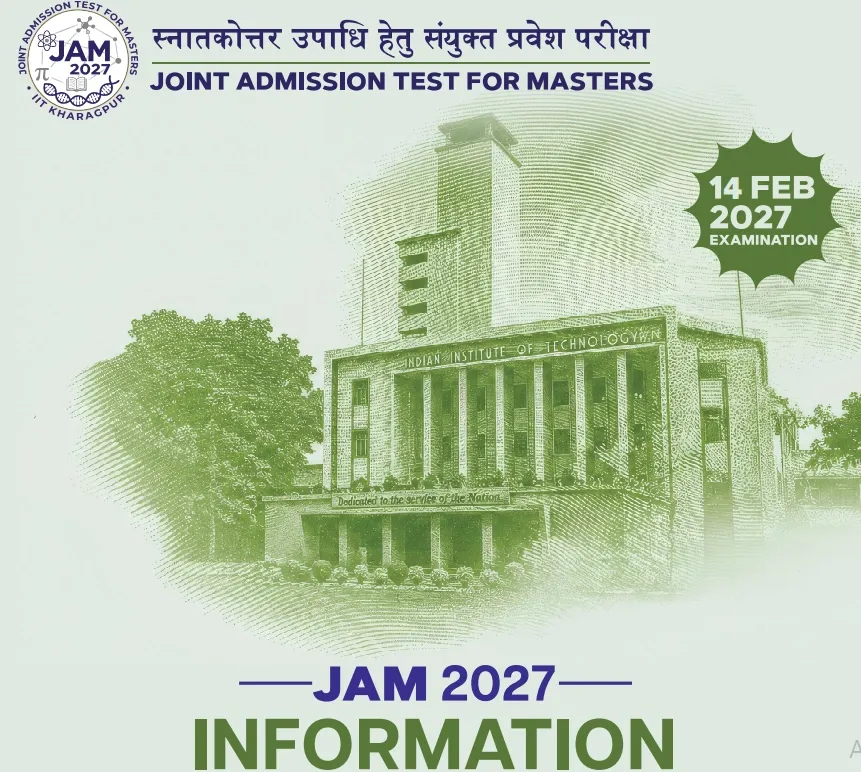
The IIT JAM Mathematics Exam Date 2027 is scheduled to be conducted on 14 February 2027 (Sunday). Joint Admission Test for Masters (JAM) 2027 Mathematics (MA) is scheduled in the Forenoon session from 9:30 AM to 12:30 PM, along with Chemistry and Geology.
Candidates can select one or two IIT JAM test papers. If choosing two papers, they must be scheduled in different sessions.
Also Read:
- IIT JAM 2027 – Complete Guide to Exam, Syllabus, Eligibility, Application & Admission
- What is IIT JAM? Courses, Colleges & Career Scope
- IIT JAM Preparation Strategy 2027: Exam Pattern, Study Plan & Tips
- IIT JAM Syllabus 2027: Subject-Wise Topics & Important Chapters
- IIT JAM 2027 Eligibility Criteria: Qualification, Age Limit, Marks & More
- IIT JAM 2027 Application Process: Registration Dates, JOAPS Form Filling & Fees
- IIT JAM Chemistry Previous Year Question Papers PDF Download
- IIT JAM Biotechnology Previous Year Question Papers PDF Download
- IIT JAM 2027 Exam Pattern: Question Types & Marking Scheme.
- IIT JAM Economics Previous Year Question Paper PDF Download
- IIT JAM Geology Previous Year Question Paper PDF Download
- IIT JAM Mathematical Statistics Previous Year Question Papers PDF Download
Download CC Learning App to Start Your IIT JAM Physics Preparation 2027!
Join Now!
Prepare for IIT JAM Mathematics With CC IIT JAM
Preparing for a competitive examination like IIT JAM 2027 becomes easier when your study is organised around concepts, syllabus coverage, PYQ practice and regular revision.
CC IIT JAM offers exam-focused learning resources for aspirants preparing for the Joint Admission Test for Masters through our expert-led IIT JAM online coaching.
With CC IIT JAM, You will Get,
- Customised Study Plans
- Complete IIT JAM Syllabus Coverage
- Live & Recorded Classes via CC Learning App
- IIT JAM Previous Year Papers & Solutions Analysis
- Topic wise Model Exams & IIT JAM Mock tests
- Regular Revisions
- Personal Mentorship
For students looking for IIT JAM online coaching, IIT JAM coaching or the best online coaching for IIT JAM, the important thing is to choose a preparation approach that supports both conceptual learning and consistent practice.
With CC IIT JAM, aspirants can complement their coaching with regular PYQ practice and mock-test analysis as they work towards IIT JAM 2027.
IIT JAM Mathematics Frequently Asked Questions
Where can I download the IIT JAM Mathematics Previous Year Question Papers PDF?
The official IIT JAM Mathematics Previous Year Question Papers PDF year-wise with answer keys can be downloaded from the links given in this article or directly from the IIT JAM official website.
Is IIT JAM Mathematics Previous Year Question Paper available with answers?
Yes. The official JAM website provides year-wise question papers with answer keys for the listed previous examinations.
How many IIT JAM Mathematics previous year papers should I solve?
Start with the latest available IIT JAM Previous Year Question Papers with Answer Keys in PDF and gradually work backwards. More important than the number of papers is analysing your mistakes and revising the concepts behind them.
Are IIT JAM Mathematics PYQs enough for preparation?
No. IIT JAM PYQs should be combined with complete syllabus coverage, conceptual study, revision and mock-test practice.
What is the IIT JAM Mathematics exam pattern?
JAM Mathematics is a CBT consisting of MCQs, MSQs and NAT questions. Negative marking applies to incorrect answers in Section A, while Sections B and C have no negative marking.
When is IIT JAM Mathematics 2027?
IIT JAM Mathematics 2027 is scheduled for 14 February 2027, from 9:30 AM to 12:30 PM in the forenoon session.
Notifications
Trending Updates


Related Blogs
September 3, 2026
IIT JAM Biotechnology Previous Year Question Papers PDF Download
8 minute read
September 3, 2026
IIT JAM Chemistry Previous Year Question Papers PDF Download
9 minute read
September 4, 2026
IIT JAM Economics Previous Year Question Paper PDF Download
11 minute read
September 5, 2026