
Table of Contents
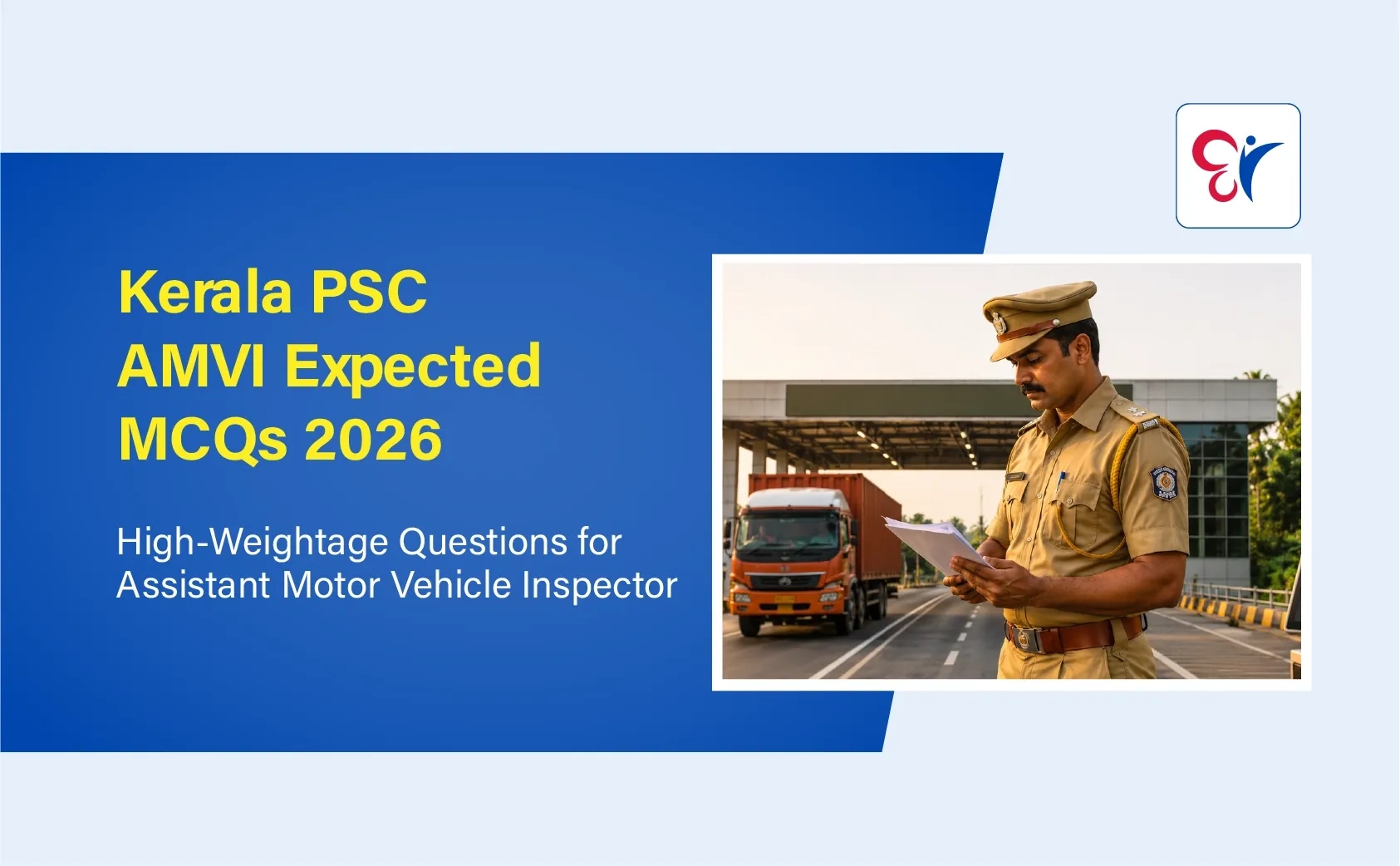
Preparing for the Kerala PSC Assistant Motor Vehicle Inspector (AMVI) Exam 2026 requires consistent preparation and practice. With a technical syllabus covering automobile engineering, mechanical engineering, driving regulations and motor vehicle laws, candidates need a focused preparation strategy to score well.
The Kerala Public Service Commission issued the AMVI recruitment notification under Category No. 26/2026 for the Motor Vehicles Department.
Scroll down to learn more about the important Kerala PSC AMVI topics, unit-wise syllabus, high-priority concepts, expected MCQs with answers and explanations, and preparation tips. The questions are designed around the prescribed syllabus and the question styles featured in previous AMVI question-paper practice.
Kerala PSC AMVI Notification 2026 – Overview
Kerala PSC published the Assistant Motor Vehicle Inspector notification under Category No. 26/2026 on 30/05/2026 for direct recruitment to the Motor Vehicles Department.
Particulars | Details |
Recruiting Authority | Kerala Public Service Commission |
Name of Post | |
Department | Motor Vehicles Department |
Category Number | |
Method of Appointment | Direct Recruitment |
Number of Vacancies | Anticipated |
Scale of Pay | ₹45,600–₹95,600 |
Age Limit | 21–40 years, with applicable relaxations |
Notification Date | 30 May 2026 |
Last Date to Apply | 1 July 2026 |
Examination Date | To be announced separately by Kerala PSC |
Kerala PSC Official Website |
Kerala PSC AMVI Exam Pattern 2026
The detailed Kerala PSC AMVI Exam Pattern 2026 provided by Kerala PSC contains three broad components:
- Technical Engineering Subjects – 80 Marks
- Driving Licence Regulations – 10 Marks
- Job-Related Topics – 10 Marks
The technical component is divided into eight units, each carrying 10 marks.
Kerala PSC AMVI Subject-wise Marks Distribution | ||
Section | Subject | Marks |
Part I – Unit I | Fluid Mechanics and Hydraulic Machines | 10 |
Part I – Unit II | Thermal Engineering | 10 |
Part I – Unit III | Strength of Materials | 10 |
Part I – Unit IV | Machine Elements, Materials and Boilers | 10 |
Part I – Unit V | Constructional Features of Engine and Related Systems | 10 |
Part I – Unit VI | Chassis | 10 |
Part I – Unit VII | Transmission System and Electrical System | 10 |
Part I – Unit VIII | Transportation Management and Modern Technologies in Automobiles | 10 |
Part II | Driving Licence Regulations | 10 |
Part III | Job-Related Topics | 10 |
Total | 100 | |
Kerala PSC AMVI Important Topics 2026 – Unit-wise Analysis
The following Kerala PSC AMVI Important Topics 2026 are selected from the detailed syllabus. Candidates should revise the full syllabus rather than depending only on a shortlist of expected questions.
Unit I – Fluid Mechanics and Hydraulic Machines (10 Marks)
Fluid mechanics deals with the properties and behaviour of fluids at rest and in motion. Hydraulic machines and fluid-flow principles are important areas for AMVI preparation.
Important Topics
- Density, specific weight, specific volume and specific gravity
- Dynamic and kinematic viscosity
- Newton's law of viscosity
- Compressibility, surface tension and capillarity
- Fluid pressure and pressure measurement
- Absolute, gauge, atmospheric and vacuum pressure
- Piezometer and manometers
- Pascal's Law
- Ideal, real, Newtonian and non-Newtonian fluids
- Orifices, notches and Venturimeter
- Steady, unsteady, uniform and non-uniform flow
- Laminar and turbulent flow
- Continuity equation
- Major and minor head losses
- Darcy's and Chezy's formula
- Properties of hydraulic oils
- Centrifugal and reciprocating pumps
- Impulse and reaction turbines
High-Priority Concepts to Revise
- Difference between dynamic and kinematic viscosity
- Newton's law of viscosity
- Pressure measuring instruments
- Difference between laminar and turbulent flow
- Working principle of Venturimeter
- Darcy's formula and head loss
- Centrifugal pump working
- Difference between impulse and reaction turbines
Unit II – Thermal Engineering (10 Marks)
Thermal engineering covers thermodynamic laws, heat engines, IC engines, compressors and heat transfer.
Important Topics
- Zeroth, First and Second Laws of Thermodynamics
- Isothermal and isentropic processes
- Work done equations and P-V diagrams
- Carnot cycle
- Otto cycle
- Diesel cycle
- Joule cycle
- Dual combustion cycle
- Two-stroke and four-stroke petrol engines
- Two-stroke and four-stroke diesel engines
- Valve timing diagrams
- Indicated Power (IP)
- Brake Power (BP)
- Frictional Power (FP)
- Mechanical and thermal efficiency
- Specific Fuel Consumption
- Morse test
- Heat balance sheet
- Single-stage and multistage compressors
- Conduction, convection and radiation
- Fourier's law of heat conduction
High-Priority Concepts to Revise
- Comparison of Otto and Diesel cycles
- Working of two-stroke and four-stroke engines
- P-V diagrams
- Valve timing diagrams
- Relationship between IP, BP and FP
- Mechanical efficiency
- Morse test
- Types of compressors
- Modes of heat transfer
Unit III – Strength of Materials (10 Marks)
Strength of Materials focuses on how engineering materials respond to external forces, stress, strain and deformation.
Important Topics
- Tensile and compressive stress
- Longitudinal stress and lateral strain
- Poisson's ratio
- Stress-strain diagram
- Elastic limit and yield point
- Ultimate stress and working stress
- Factor of safety
- Hooke's Law
- Principle of superposition
- Young's Modulus
- Bulk Modulus
- Modulus of Rigidity
- Thermal stress and strain
- Types and laws of friction
- Centre of gravity
- Moment of inertia
- Shear force and bending moment
- Cantilever and simply supported beams
- Rivets, bolts and riveted joints
- Springs and spring stiffness
- Welded joints
High-Priority Concepts to Revise
- Stress and strain calculations
- Hooke's Law
- Elastic limit and yield point
- Relationship between elastic constants
- Factor of safety
- Bending moment and shear force
- Types of beams and loading conditions
- Spring stiffness and deflection
- Riveted and welded joints
Unit IV – Machine Elements, Materials and Boilers (10 Marks)
This unit covers machine components, mechanical devices, engineering materials and boilers.
Important Topics
- Radial and thrust bearings
- Sliding and rolling contact bearings
- Journal bearings
- Bearing characteristic number
- Functions and types of governors
- Equilibrium speed and sensitiveness
- Stability and hunting of governors
- Flywheel functions
- Fluctuation of speed and energy
- Energy stored in flywheels
- Types of gears
- Spur gear nomenclature
- Gear trains and velocity ratio
- Types of boilers
- Boiler accessories and mountings
- Steam engine parts and working
- Cast iron and steel
- Classification of steel
- Heat treatment methods
- Alloy steels
- Non-ferrous metals and alloys
High-Priority Concepts to Revise
- Difference between flywheel and governor
- Functions of bearings
- Types of bearings
- Gear terminology and gear ratio
- Types of gear trains
- Boiler mountings and accessories
- Heat treatment of metals
- Properties and applications of engineering materials
Unit V – Constructional Features of Engine and Related Systems (10 Marks)
This unit is particularly relevant to automobile engineering. It covers IC engine components, fuel supply, lubrication and cooling systems.
Important Topics
IC Engine Components
- Cylinder block and cylinder liner
- Cylinder head and gasket
- Piston and piston rings
- Connecting rod
- Crankshaft
- Engine valves
- Camshaft
- Valve operating mechanisms
Fuel System
- Fuel feed systems
- Mechanical and electrical fuel pumps
- Carburettors
- Simple carburettor working
- Float system
- Idle and high-speed systems
- Acceleration pump and choke
- Variable Valve Timing (VVT)
- Continuously Variable Valve Timing (CVVT)
- Catalytic converter and muffler
- Diesel fuel system
- Fuel injectors
- Turbocharger and turbo lag
Lubrication and Cooling Systems
- Wet and dry sump lubrication
- Splash and pressure-feed lubrication
- Oil pumps and pressure relief valves
- Oil coolers and oil filters
- Air and water cooling
- Thermo-syphon system
- Pump circulation system
- Thermostat
- Radiator and pressure cap
- Coolants and antifreeze solutions
High-Priority Concepts to Revise
- Functions of piston rings
- Cylinder liner types
- Working of carburettor
- Petrol and diesel fuel supply systems
- Turbocharger working
- VVT and CVVT
- Catalytic converter
- Types of lubrication systems
- Thermostat and radiator functions
- Difference between air and water cooling
Unit VI – Chassis (10 Marks)
The chassis unit covers the structural and control systems of motor vehicles.
Important Topics
- Chassis and frame construction
- Types of frames
- Front axle and rear axle
- Dead axle and live axle
- Stub axle arrangements
- Suspension systems
- Leaf and coil springs
- Shock absorbers
- Telescopic shock absorbers
- Ackermann and Davis steering mechanisms
- Steering gearboxes
- Worm and roller steering
- Rack and pinion steering
- Power steering
- Wheel alignment
- Mechanical, hydraulic and pneumatic brakes
- Drum and disc brakes
- Master cylinder and wheel cylinder
- Brake bleeding
- Servo brakes and air brakes
High-Priority Concepts to Revise
- Types of chassis frames
- Suspension system components
- Leaf spring and coil spring
- Working of telescopic shock absorbers
- Ackermann steering principle
- Steering gearbox types
- Wheel alignment factors
- Hydraulic braking system
- Difference between drum and disc brakes
- Master cylinder and wheel cylinder
Unit VII – Transmission System and Electrical System (10 Marks)
This unit deals with the transmission of engine power to the driving wheels and the electrical systems of automobiles.
Important Topics
Transmission System
- Working principle of clutches
- Single-plate and multi-plate clutches
- Diaphragm clutch
- Cone clutch
- Centrifugal clutch
- Hydraulic and electromagnetic clutches
- Sliding mesh gearbox
- Constant mesh gearbox
- Synchromesh gearbox
- Epicyclic gearbox
- Torque converter
- CVT and automatic transmission
- Propeller shaft
- Universal joint
- Constant velocity joint
- Differential mechanism
- Front-wheel drive and rear-wheel drive
- Rear axles
- Spoked, disc and alloy wheels
- Tyre construction and tread patterns
- Tubeless tyres
Electrical System
- Dynamo and alternator
- Charging system
- Voltage regulators
- Starter motor
- Bendix drive
- Overrunning clutch
- Ignition systems
- Ignition coil and spark plug
- Contact breaker points
- Magneto ignition
- Electronic ignition
- Transistorised ignition
- Computer-controlled ignition
High-Priority Concepts to Revise
- Functions of clutch
- Difference between sliding mesh, constant mesh and synchromesh gearboxes
- Working of torque converter
- Function of differential
- Universal joint and CV joint
- Alternator and dynamo
- Starter motor mechanisms
- Types of ignition systems
- Tyre construction and inflation pressure
Unit VIII – Transportation Management and Modern Technologies in Automobiles (10 Marks)
This unit combines transport administration, road geometry, vehicle safety, modern automobile technologies and environmental protection.
Important Topics
Transportation Management
- Features of the Motor Vehicles Act
- Registration of vehicles
- Duties of drivers and conductors
- Traffic signs
- Motor Transport Organisation and functional wings
- Road geometry
- Highway width and gradient
- Super elevation
- Sight distance
- Road intersections
- Vehicle insurance
- Classification of insurance policies
Fuel Injection and Emission Control
- Electronic Fuel Injection (EFI)
- Multi-Point Fuel Injection (MPFI)
- Gasoline Direct Injection (GDI)
- Throttle Body Injection
- Sensors and actuators
- Common Rail Diesel Injection (CRDI)
- Electronic Control Module (ECM)
- Catalytic converter
- Exhaust Gas Recirculation (EGR)
- Positive Crankcase Ventilation (PCV)
- Evaporative emission control
- Diesel smoke control
- Emission norms
Modern Automobile Technologies
- Cruise control
- Automatic climate control
- Parking distance control
- Seat belts and airbags
- Electronic Stability Control
- Anti-lock Braking System (ABS)
- Vehicle immobiliser
- Automatic traction control
- GPS
- Hybrid vehicles
- Electric vehicles
- EV components and drive systems
High-Priority Concepts to Revise
- EFI, MPFI and GDI
- CRDI working
- Catalytic converter and EGR
- Vehicle emission control systems
- ABS and electronic stability control
- Airbags and seat belts
- Hybrid and electric vehicle components
- GPS and vehicle safety technologies
Click Here for Kerala PSC AMVI Syllabus 2026 PDF Download
Kerala PSC AMVI Expected MCQs 2026 – Practice Questions with Answers
The following Kerala PSC AMVI Expected MCQs 2026 are prepared from the important topics in the detailed syllabus and concepts represented in the previous AMVI question-paper resource. They are original revision questions and are not official predictions of the examination paper.
Section 1: Fluid Mechanics and Hydraulic Machines
1. According to Newton's law of viscosity, shear stress in a Newtonian fluid is directly proportional to:
A. Pressure gradient
B. Rate of shear strain
C. Density
D. Surface tension
Answer: B. Rate of shear strain
Explanation: Newton's law of viscosity states that shear stress is proportional to the velocity gradient perpendicular to the direction of flow.
2. A Venturimeter is preferred over an orifice meter mainly because it:
A. Has no pressure difference
B. Has lower energy loss
C. Requires no installation
D. Measures temperature
Answer: B. Has lower energy loss
Explanation: A Venturimeter measures flow using the pressure difference between its inlet and throat. Its design generally produces lower permanent pressure loss than an orifice meter.
3. Which of the following is an impulse turbine?
A. Francis turbine
B. Kaplan turbine
C. Pelton turbine
D. Propeller turbine
Answer: C. Pelton turbine
Explanation: A Pelton turbine is an impulse turbine in which the water jet transfers kinetic energy to the turbine buckets.
Section 2: Thermal Engineering
4. The ideal Otto cycle consists of:
A. Two constant-pressure and two constant-volume processes
B. Two isothermal and two isentropic processes
C. Two constant-volume and two isentropic processes
D. Two constant-pressure and two isothermal processes
Answer: C. Two constant-volume and two isentropic processes
Explanation: The ideal Otto cycle consists of two constant-volume processes and two isentropic processes.
5. Mechanical efficiency of an IC engine is given by:
A. IP/BP
B. BP/IP
C. FP/BP
D. IP/FP
Answer: B. BP/IP
Explanation: Mechanical efficiency is the ratio of brake power to indicated power.
6. The Morse test is used to determine:
A. Volumetric efficiency
B. Indicated power of individual cylinders
C. Brake thermal efficiency
D. Specific fuel consumption
Answer: B. Indicated power of individual cylinders
Explanation: The Morse test estimates the indicated power of individual cylinders in a multicylinder engine by successively cutting out cylinders and observing the change in brake power.
Section 3: Strength of Materials
7. Hooke's Law states that, within the elastic limit:
A. Stress is inversely proportional to strain
B. Stress is directly proportional to strain
C. Stress is independent of strain
D. Strain is always zero
Answer: B. Stress is directly proportional to strain
Explanation: Within the proportional limit, stress is directly proportional to strain.
8. The ratio of longitudinal strain to lateral strain is known as:
A. Young's modulus
B. Bulk modulus
C. Poisson's ratio
D. Modulus of rigidity
Answer: C. Poisson's ratio
Explanation: Poisson's ratio is the ratio of lateral strain to longitudinal strain in magnitude. The question's wording should be understood in terms of the conventional definition.
Section 4: Machine Elements, Materials and Boilers
9. Which component is primarily used to reduce fluctuations in the speed of an engine during a cycle?
A. Governor
B. Flywheel
C. Bearing
D. Clutch
Answer: B. Flywheel
Explanation: A flywheel stores energy when the engine produces excess energy and releases it when the energy output is lower, reducing cyclic speed fluctuations.
10. The module of a spur gear is defined as:
A. Number of teeth divided by pitch circle diameter
B. Pitch circle diameter divided by number of teeth
C. Circular pitch divided by number of teeth
D. Addendum divided by dedendum
Answer: B. Pitch circle diameter divided by number of teeth
Section 5: Engine Construction and Related Systems
11. Which piston ring primarily controls the lubricating oil on the cylinder wall?
A. Compression ring
B. Oil control ring
C. Gudgeon pin
D. Connecting rod
Answer: B. Oil control ring
Explanation: The oil control ring regulates the lubricating oil film on the cylinder wall and prevents excessive oil from entering the combustion chamber.
12. The main function of a thermostat in an engine cooling system is to:
A. Increase fuel pressure
B. Regulate coolant flow according to engine temperature
C. Increase lubrication pressure
D. Control ignition timing
Answer: B. Regulate coolant flow according to engine temperature
Explanation: The thermostat controls coolant circulation to help the engine reach and maintain its operating temperature.
Section 6: Chassis
13. The Ackermann steering mechanism is designed to:
A. Increase engine speed
B. Ensure correct steering geometry while turning
C. Increase braking pressure
D. Reduce transmission losses
Answer: B. Ensure correct steering geometry while turning
Explanation: Ackermann steering geometry allows the inner front wheel to turn through a greater angle than the outer wheel, reducing tyre scrubbing during a turn.
14. The main function of an Anti-lock Braking System (ABS) is to:
A. Increase engine power
B. Prevent wheel locking during braking
C. Increase tyre pressure
D. Reduce fuel consumption
Answer: B. Prevent wheel locking during braking
Explanation: ABS helps prevent wheel lock during hard braking, assisting the driver in maintaining steering control.
Section 7: Transmission and Electrical Systems
15. The primary function of a clutch in an automobile is to:
A. Increase engine compression
B. Connect and disconnect engine power from the transmission
C. Control engine temperature
D. Charge the battery
Answer: B. Connect and disconnect engine power from the transmission
Explanation: The clutch allows the engine to be temporarily disconnected from the gearbox during gear changes and vehicle starting.
16. The differential mechanism allows the driving wheels to:
A. Rotate at different speeds while turning
B. Rotate only at the same speed
C. Stop independently during acceleration
D. Increase engine compression
Answer: A. Rotate at different speeds while turning
Explanation: The differential allows the inner and outer driving wheels to rotate at different speeds while negotiating a turn.
17. Which component converts mechanical energy into electrical energy in an automobile charging system?
A. Starter motor
B. Alternator
C. Clutch
D. Differential
Answer: B. Alternator
Explanation: The alternator converts mechanical energy from the engine into electrical energy to supply vehicle electrical loads and charge the battery.
Section 8: Transportation Management and Modern Technologies
18. CRDI stands for:
A. Common Rail Direct Injection
B. Controlled Rotation Diesel Ignition
C. Common Rotary Diesel Indicator
D. Central Rail Drive Injection
Answer: A. Common Rail Direct Injection
Explanation: CRDI is a diesel fuel injection system in which fuel is stored in a common high-pressure rail and delivered to the injectors.
19. The main function of an Exhaust Gas Recirculation (EGR) system is to:
A. Increase engine displacement
B. Reduce nitrogen oxide emissions
C. Increase tyre grip
D. Improve battery charging
Answer: B. Reduce nitrogen oxide emissions
Explanation: EGR recirculates a controlled amount of exhaust gas into the intake system, reducing peak combustion temperatures and helping lower NOx emissions.
20. Which of the following is a major component of a battery electric vehicle's drive system?
A. Carburettor
B. Electric motor
C. Diesel injection pump
D. Exhaust manifold
Answer: B. Electric motor
Explanation: A battery electric vehicle uses stored electrical energy to power an electric motor that drives the wheels.
Section 9: Motor Vehicles Act and Driving Regulations
21. Which section of the Motor Vehicles Act, 1988, deals with the necessity for registration of motor vehicles?
A. Section 39
B. Section 52
C. Section 56
D. Section 66
Answer: A. Section 39
Explanation: Section 39 deals with the necessity for registration of motor vehicles.
22. Section 129 of the Motor Vehicles Act, 1988, deals with:
A. Vehicle registration
B. Wearing of protective headgear
C. Vehicle insurance
D. Driving licences
Answer: B. Wearing of protective headgear
Explanation: Section 129 concerns the requirement to wear protective headgear while riding or driving a motorcycle, subject to the provisions of the Act.
23. Which section deals with the necessity for insurance against third-party risks?
A. Section 112
B. Section 128
C. Section 146
D. Section 181
Answer: C. Section 146
Explanation: Section 146 deals with the requirement of insurance against third-party risks.
24. Which section of the Kerala Motor Vehicles Taxation Act, 1976, deals with the levy of Green Tax?
A. Section 2(e)
B. Section 3
C. Section 3A
D. Section 6
Answer: C. Section 3A
Explanation: Section 3A of the Kerala Motor Vehicles Taxation Act, 1976, deals with the levy of Green Tax.
Kerala PSC AMVI Previous Year Question Papers – Why Should You Practise Them?
Practising Kerala PSC AMVI Previous Year Question Papers is an important part of AMVI preparation. It helps candidates understand how technical concepts are converted into objective questions.
CC Learning App’s existing AMVI previous-year-question-paper resource includes practice questions from topics such as:
- Fluid mechanics and viscosity
- Hydraulic machines
- Thermodynamic cycles
- IC engine performance
- Heat transfer
- Bearings and flywheels
- Gears and machine elements
These questions provide useful practice in the technical areas covered by the AMVI syllabus.
Read and practise: Kerala PSC AMVI Previous Year Question Paper 2026
Download CC Learning App, strengthen your technical knowledge, practise consistently and prepare for the next AMVI exam with expert guidance!
Join Now!
Prepare for Kerala PSC AMVI with CC Learning App
Preparing for the Kerala PSC AMVI exam requires more than memorising technical definitions. Candidates need a structured approach to understand engineering concepts, revise important automobile systems, practise numerical problems and learn the relevant motor vehicle laws.
CC Learning App, a multi learning platform, offers the best Kerala PSC AMVI Coaching, designed to support candidates through a systematic learning and practice approach.
With the CC Learning App, candidates get
- Live and recorded classes
- Subject-wise technical learning
- Study materials and revision notes
- Chapter-wise MCQ practice
- Previous-question discussions
- Mock tests and practice sessions
- Expert guidance and academic support
- Personal mentorship
Don't leave your preparation to chance. Download CC Learning App, strengthen your technical knowledge, practise consistently and prepare for the next AMVI exam with expert guidance.
Kerala PSC AMVI 2026 Frequently Asked Questions
What are the most important topics for the Kerala PSC AMVI exam 2026?
Important areas include fluid mechanics, thermal engineering, strength of materials, machine elements, IC engine construction, fuel systems, chassis, braking systems, transmission, electrical systems, modern automobile technologies and the Motor Vehicles Act.
Which subject carries the highest marks in the Kerala PSC AMVI exam?
According to the detailed syllabus, the eight technical units together carry 80 marks. Each technical unit carries 10 marks. Driving licence regulations and job-related topics account for the remaining 20 marks.
How many marks are allotted for automobile engineering in the AMVI exam?
The detailed syllabus allocates 80 marks to the eight technical units covering mechanical and automobile engineering subjects.
What are the important IC engine topics for Kerala PSC AMVI?
Important topics include cylinder block, cylinder head, piston, piston rings, connecting rod, crankshaft, valves, camshaft, fuel supply systems, carburettors, fuel injectors, turbochargers, lubrication and cooling systems.
Is the Motor Vehicles Act included in the Kerala PSC AMVI syllabus?
Yes. The job-related section includes 7 marks from the Motor Vehicles Act, 1988, and 3 marks from the Kerala Motor Vehicles Taxation Act, 1976, according to the detailed syllabus.
Which sections of the Motor Vehicles Act are important for AMVI?
Important sections include Section 39 (registration), Section 52 (alteration of vehicles), Section 56 (fitness certificate), Section 66 (permits), Section 112 (speed limits), Section 129 (protective headgear), Section 134 (duties in accidents), Section 146 (third-party insurance) and other provisions listed in the official syllabus.
Are driving licence regulations included in the AMVI examination?
Yes. The detailed syllabus allocates 10 marks to driving licence topics, including the Motor Vehicles (Driving) Regulations, 2017, and Chapter II of the Motor Vehicles Act, 1988.
What are the important topics in the AMVI chassis section?
Candidates should prepare chassis frames, axles, suspension systems, springs, shock absorbers, steering mechanisms, wheel alignment, hydraulic brakes, drum brakes, disc brakes and air brakes.
How can I prepare for Kerala PSC AMVI in a short period?
Prioritise the eight technical units, revise important automobile systems, practise formula-based questions, study the listed Motor Vehicles Act sections and attempt regular MCQs and mock tests.
Notifications
Trending Updates


Related Blogs

May 13, 2026
AMVI Kerala PSC 2026 Recruitment (Assistant Motor Vehicle Inspector) : Complete Guide
6 minute read
March 14, 2023
Best Coaching for Kerala PSC AMVI - Crash Course | Online
2 minute read
May 13, 2026
Kerala PSC AMVI Eligibility Criteria 2026: Age Limit, Qualification & Licence Requirements
7 minute read
March 6, 2026