
Table of Contents
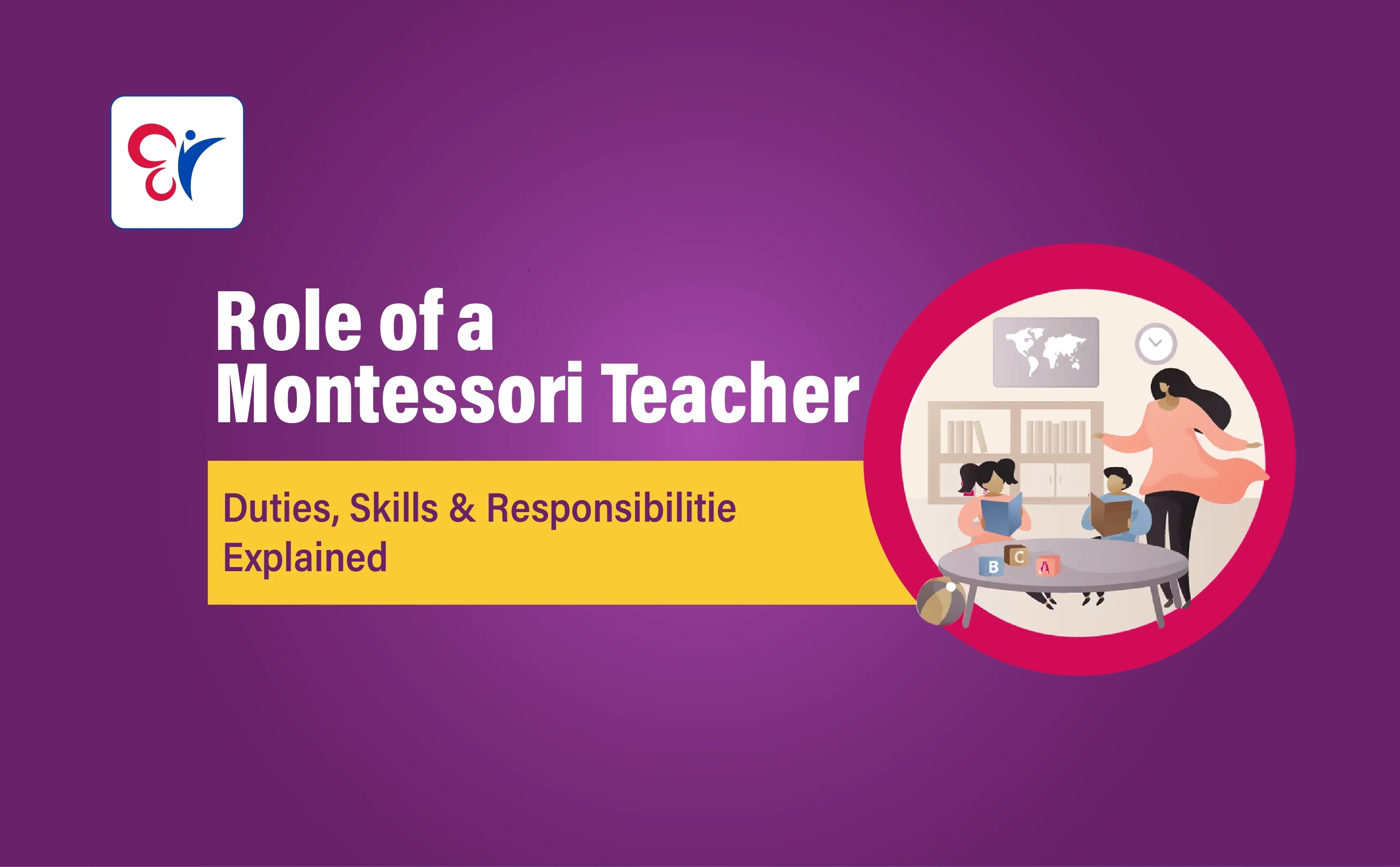
The role of a Montessori teacher goes beyond delivering classroom lessons. From preparing a child-friendly learning environment to observing development and introducing Montessori activities, teachers guide children towards independent learning. For aspirants considering Montessori teacher training in Kerala, understanding the duties, responsibilities, skills and qualifications of a Montessori teacher is essential. This article explains the Montessori teacher job role, key skills and career opportunities to help you take the right next step.
What Is the Role of a Montessori Teacher?
A Montessori teacher primarily acts as a guide, observer and facilitator, helping children connect with a carefully prepared learning environment. The teacher observes each child, understands their developmental needs and introduces appropriate Montessori materials based on their readiness.
Rather than standing at the front and delivering lessons, the teacher demonstrates activities, observes how children use the materials, maintains the classroom environment and provides guidance when needed. The goal is to encourage independence, concentration, coordination, confidence, responsibility and social skills.
According to the Association Montessori Internationale (AMI), Montessori environments include mixed-age groups, accessible materials, suitable workspaces and opportunities for hands-on, self-directed learning. The teacher's role is therefore to create supportive conditions where children can learn independently while receiving guidance when necessary.
Join now on the Best Montessori TTC Course in Kerala by CC Learning App
Tap Here
Key Duties of a Montessori Teacher
The duties of a Montessori teacher cover much more than classroom instruction. From preparing learning materials to observing children's progress, the teacher is involved in several aspects of the educational process.
1. Preparing the Montessori Learning Environment
Creating and maintaining the prepared environment is one of the important Montessori teacher responsibilities. The classroom needs to be organised in a way that allows children to access appropriate materials and participate in activities with increasing independence.
A Montessori teacher may be responsible for:
- Arranging classroom materials
- Checking that materials are complete and usable
- Maintaining cleanliness and order
- Creating suitable work areas
- Keeping materials accessible to children
- Maintaining a safe classroom environment
- Adjusting the classroom according to children's needs
A well-prepared environment can help children understand where materials belong and encourage them to take responsibility for returning items after use.
2. Observing Children
Observation is one of the most important Montessori teacher skills. Instead of immediately correcting or directing a child, the teacher observes what the child is doing, how the child interacts with materials and whether the child is ready for a new activity.
Observation can help the teacher understand:
- A child's interests
- Concentration level
- Coordination
- Independence
- Social interaction
- Repetition of activities
- Response to new materials
- Areas where additional guidance may be useful
Good observation requires patience and objectivity. The teacher should observe carefully without unnecessarily disturbing a child's concentration.
3. Introducing Montessori Materials
Montessori classrooms use specialised materials for different areas of learning. The teacher needs to understand the purpose and appropriate presentation of these materials.
A Montessori teacher may demonstrate an activity carefully and then allow the child to practise independently. The teacher needs to understand:
- How should the material be presented?
- What activity is intended to develop?
- When the child may be ready for it?
- How much assistance should be provided?
- When to step back and observe?
This is why professional Montessori teacher training can be valuable for aspiring educators.
4. Supporting Independent Learning
One of the major aims of Montessori education is to help children become increasingly independent.
A Montessori teacher provides children with appropriate choices while maintaining classroom expectations. Children can work independently, repeat activities and gradually develop confidence in completing tasks.
This approach is often associated with the principle of freedom within limits.
Freedom does not mean an absence of rules. Children are expected to respect the classroom, materials, teachers and other children.
5. Teaching Practical Life Skills
Practical Life activities are an important part of Montessori education, particularly in early childhood settings.
Activities can include:
- Pouring
- Folding
- Sorting
- Cleaning
- Washing
- Arranging objects
- Caring for classroom materials
- Caring for plants
- Dressing-related activities
These activities give children opportunities to practise coordination, concentration, independence and responsibility. The Montessori teacher demonstrates the activity clearly and allows children to practise it at their own pace.
6. Supporting Language Development
Montessori education includes activities that support children's language development. Depending on the child's age and Montessori programme, activities may introduce:
- Vocabulary
- Listening
- Speaking
- Sound awareness
- Writing preparation
- Reading
- Word formation
- Communication
The teacher observes the child's readiness and introduces activities progressively.
7. Supporting Early Mathematical Development
Montessori classrooms also provide hands-on opportunities to develop mathematical understanding. Activities may introduce concepts such as:
- Counting
- Quantity
- Number recognition
- Place value
- Basic operations
- Measurement
- Patterns
- Mathematical relationships
Instead of relying only on verbal explanation, Montessori materials can provide children with concrete experiences that help them understand abstract concepts progressively.
8. Maintaining Classroom Discipline and Safety
A Montessori classroom provides freedom within clearly defined boundaries. The teacher needs to maintain a calm, respectful and safe environment. Children should understand expectations regarding movement, use of materials and interaction with others.
Classroom management responsibilities may include:
- Establishing consistent routines
- Maintaining safety
- Guiding respectful behaviour
- Helping children resolve conflicts
- Protecting the learning environment
- Encouraging responsibility for classroom materials
Effective Montessori classroom management requires consistency rather than constant correction.
9. Supporting Social and Emotional Development
A Montessori teacher also contributes to children's social and emotional development.
Teachers can model:
- Respect
- Courtesy
- Patience
- Cooperation
- Empathy
- Responsibility
- Conflict resolution
Children learn not only through formal activities but also through interactions with teachers and classmates.
10. Communicating With Parents
Communication with parents is another important part of the Montessori teacher job role. Teachers may discuss a child's classroom experiences, interests, progress and areas that may require additional attention.
Professional communication should be clear, respectful and based on careful observation rather than assumptions. Maintaining positive parent-teacher relationships can help create better communication between the home and educational environment.
Essential Skills & Qualities of a Montessori Teacher
A successful Montessori teacher needs both professional knowledge and personal qualities. Being a Montessori teacher requires more than completing a course. The educator's attitude and approach towards children also matter. Some important qualities of a Montessori teacher include:
Patience : Children may need time to understand and repeat an activity. A patient teacher avoids unnecessary interruption and allows children to develop at their own pace.
Observation Skills : A teacher needs to notice small changes in a child's behaviour, concentration, interests and interaction with materials.
Respect for Children : Montessori education places strong emphasis on treating children with respect and recognising them as active participants in their own development.
Communication Skills : Teachers need to communicate clearly with children, parents and colleagues.
Organisation : A Montessori classroom depends heavily on order. Teachers need to ensure that materials and learning spaces are properly maintained.
Empathy : Understanding children's feelings and individual differences can help create a supportive learning environment.
Adaptability : Children do not all learn in exactly the same way or at the same pace. Teachers need to respond appropriately to individual needs.
Montessori Teacher vs Traditional Teacher
The exact role varies between schools, but Montessori education generally gives greater emphasis to the teacher as a guide and observer.
Montessori Teacher | Traditional Classroom Teacher |
Guides children's activities | Often leads whole-class instruction |
Observes individual children closely | Often follows a common lesson plan |
Uses specialised Montessori materials | May use textbooks, worksheets and other resources |
Supports independent work | Often directs the pace of classroom activities |
Provides individual or small-group presentations | Frequently teaches the whole class together |
Maintains a prepared environment | Works within the school's regular classroom structure |
This comparison does not mean that all conventional classrooms operate in exactly the same way. Teaching practices vary according to the school, curriculum, age group and educational philosophy.
Prepare for a Montessori Teaching Career With CC Learning App
Starting a career in Montessori education requires a strong understanding of child development, Montessori principles, teaching practices and classroom responsibilities.
CC Learning App, a multi learning platform, can support aspirants who are building their knowledge for a Montessori teaching career. Structured learning can help candidates understand important concepts, revise key topics and develop greater confidence before entering the early childhood education field.
If you are planning to pursue Montessori teacher training in Kerala or build your knowledge of Montessori education, developing a strong foundation can make your preparation more focused.
Kickstart your Montessori TTC journey with CC Learning App.
Download the CC Learning app now and Start Your Montessori TTC Journey
Tap Here
Frequently Asked Questions
1. What is the main role of a Montessori teacher?
The main role of a Montessori teacher is to prepare the learning environment, observe children, introduce appropriate Montessori activities and guide children towards independent learning.
2. What are the duties of a Montessori teacher?
The main duties include preparing the classroom, observing children, presenting Montessori materials, supporting practical life activities, maintaining classroom order, monitoring children's development and communicating with parents.
3. What skills does a Montessori teacher need?
Important Montessori teacher skills include observation, patience, communication, empathy, organisation, classroom management, child development knowledge and familiarity with Montessori materials.
4. Is a Montessori teacher a traditional teacher?
The Montessori teacher's role is different in several ways. Montessori teachers generally act as guides and observers while providing individual or small-group lessons and supporting independent activities.
5. What is Montessori teacher training?
Montessori teacher training is specialised education that introduces candidates to Montessori philosophy, child development, classroom practices, observation and the use of Montessori materials. The structure and recognition of programmes can vary.
6. Can I become a Montessori teacher in Kerala?
Yes. Candidates in Kerala can explore Montessori teacher-training programmes and opportunities in Montessori schools, preschools and other early childhood education settings. Specific qualification requirements depend on the programme and employer.
7. What is the most important skill for a Montessori teacher?
Observation is one of the most important skills because it helps teachers understand children's interests, development and readiness for new activities. Patience, communication and knowledge of child development are also essential.
Notifications
Trending Updates



Related Blogs
January 29, 2026
AMI Montessori vs IMC Montessori
4 minute read
January 31, 2026
Best Montessori TTC Institutes in India
6 minute read
December 16, 2025
Montessori TTC Course 2026 : Certificate Details, Career Scope & Eligibility
4 minute read
September 29, 2026
Montessori Myths vs Facts: 10 Common Misconceptions About Montessori Education
11 minute read
January 29, 2026