
Table of Contents
Cyber threats are evolving rapidly, putting businesses, financial institutions, educational organisations and government systems at constant risk. Phishing, ransomware, malware and data breaches can cause serious damage when threats go undetected. This is where a Security Operations Center (SOC) becomes essential. This article covers SOC meaning, roles and responsibilities, and tools. Scroll down to learn more about SOC in cyber security.
What Is SOC in Cyber Security?
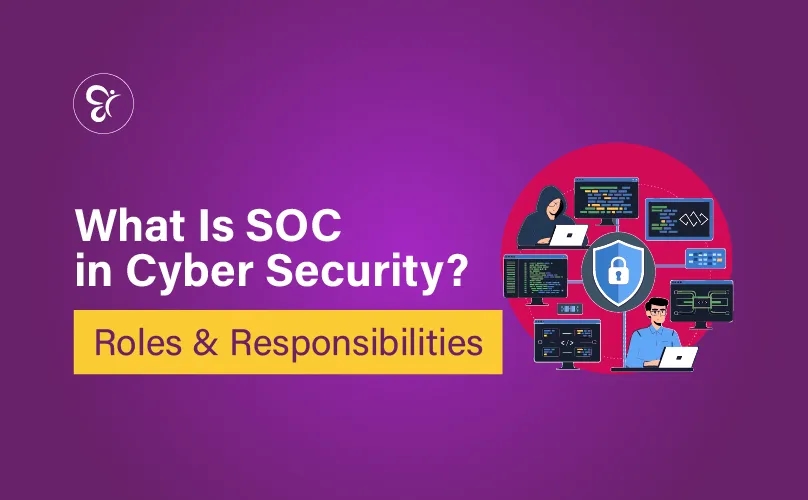
SOC stands for Security Operations Center. In cybersecurity, SOC acts as a security control centre for an organisation. It continuously monitors digital systems to identify possible threats and helps protect sensitive data, applications and networks from cyberattacks.
Depending on the organisation, a SOC may monitor:
- Computer networks
- Servers and databases
- Laptops and desktops
- Cloud environments
- Applications
- User accounts and identities
- Email systems
- Security devices
- System and application logs
The central purpose of a SOC is to provide continuous visibility into an organisation's security environment and help identify potential threats before they cause serious damage.
A SOC is therefore much more than a physical room where analysts watch security dashboards. Modern SOC operations combine people, processes and technology to manage cybersecurity events efficiently.
A Quick Overview of SOC in Cyber Security
Particular | Details |
Full Form | Security Operations Center |
Primary Purpose | Monitor, detect, investigate and respond to cyber threats |
Key Professionals | SOC Analysts, Security Engineers, Threat Hunters and SOC Managers |
Major Technologies | SIEM, EDR, XDR, SOAR and threat intelligence platforms |
Main Activities | Security monitoring, alert triage, investigation and incident response |
Career Opportunities | SOC Analyst, Incident Responder, Threat Hunter and Security Engineer |

How Does a Security Operations Center (SOC) Work?
A typical SOC operation follows a continuous cycle. Although processes differ between organisations, the basic workflow generally involves monitoring, detection, triage, investigation, response and improvement.
1. Continuous Security Monitoring
The SOC continuously monitors activity across an organisation's systems and devices. This may include:
- Login activity
- Network connections
- Endpoint activity
- Firewall logs
- Application activity
- Authentication events
- Cloud activity
- Malware alerts
The main goal is to spot unusual activity that could indicate a security threat.
2. Threat Detection
Security tools generate alerts when they detect potentially suspicious activity. For example, an alert may be triggered by:
- Multiple failed login attempts
- Suspicious network traffic
- Malware activity
- Unusual user behaviour
- Login from an unexpected location
- Unusual data transfers
- Communication with a suspicious IP address
However, an alert does not always mean that a cyberattack has happened. The SOC team needs to check the alert before taking action.
3. Alert Triage
Alert triage means reviewing alerts and deciding which ones need further investigation.
SOC analysts may check:
- How serious the alert is
- Which system is affected
- Which user is involved
- What activity occurred
- What evidence is available
- What the possible impact could be
False alarms or low-risk alerts may be closed, while suspicious alerts are investigated further.
4. Security Incident Investigation
If an alert appears to be a real threat, the SOC analyst investigates the incident. The investigation may include checking:
- System logs
- Network activity
- Endpoint information
- Login records
- User activity
- Threat intelligence
- Related security events
The goal is to understand what happened, how it happened and which systems or accounts may be affected.
5. Incident Response
When a genuine security incident is confirmed, the SOC team takes appropriate action based on the organisation's response procedures. This may include:
- Isolating an affected device
- Blocking malicious network traffic
- Disabling a compromised account
- Removing malicious files
- Escalating the incident
- Collecting evidence
- Supporting system recovery
The response depends on the type and severity of the incident.
6. Recovery and Improvement
After the incident is controlled, the security team reviews what happened and looks for ways to prevent similar incidents in the future. This may involve improving:
- Detection rules
- Security controls
- Monitoring processes
- Incident-response procedures
- Employee security awareness
- Threat intelligence
- Overall security setup
This is why SOC operations are continuous. The process does not end after one security incident. Teams continue monitoring, responding and improving their security practices.
What Are the Main SOC Roles and Responsibilities?
A SOC team may include several cybersecurity professionals. The exact structure depends on the size and requirements of the organisation.
1. SOC Analyst - Level 1
An SOC L1 analyst generally handles initial alert monitoring and triage. Typical responsibilities include:
- Monitoring security dashboards
- Reviewing incoming alerts
- Performing initial analysis
- Identifying potential threats
- Documenting security events
- Escalating suspicious incidents
For beginners, the Security Operations Center analyst L1 role can be an important entry point into cybersecurity operations.
2. SOC Analyst - Level 2
A Level 2 SOC analyst handles more detailed investigations. Responsibilities may include:
- Investigating escalated alerts
- Correlating multiple security events
- Analysing endpoint and network evidence
- Determining the scope of incidents
- Supporting containment
- Preparing investigation reports
3. SOC Analyst - Level 3
A Level 3 SOC analyst generally works on advanced security investigations and complex threats. Depending on the organisation, responsibilities can include:
- Advanced threat hunting
- Detection engineering
- Malware analysis
- Complex incident investigation
- Reverse engineering
- Advanced security research
4. Threat Hunter
Threat hunters proactively search for suspicious activity that may not have been identified by automated security controls. Instead of waiting for an alert, threat hunters use security data, intelligence and analytical techniques to look for signs of compromise.
5. Security Engineer
Security engineers design, implement and maintain security technologies and infrastructure. They may work with:
- SIEM platforms
- Endpoint security
- Network security
- Security architecture
- Detection systems
- Cloud security technologies
6. SOC Manager
The Security Operations Center manager oversees the overall security operations function. Responsibilities may include:
- Managing SOC personnel
- Developing operational procedures
- Monitoring performance
- Coordinating incident response
- Managing security technologies
- Reporting security activities to senior leadership
What Are the Tools Used in a SOC?
SOC teams use different cybersecurity tools to monitor systems, detect threats, investigate incidents and respond to security problems. Some of the common tools used in a SOC include:
1. SIEM - Security Information and Event Management
A SIEM collects security logs and events from different systems and brings them together in one place. It helps SOC analysts monitor activity, identify suspicious behaviour and investigate security incidents.
2. EDR - Endpoint Detection and Response
EDR focuses on devices such as laptops, desktops and servers. It monitors endpoint activity and helps security teams identify and investigate potentially harmful activities.
3. XDR - Extended Detection and Response
XDR provides security visibility across multiple areas of an organisation. Depending on the tool, it can bring together information from endpoints, networks, email, cloud systems, identities and applications.
5. SOAR - Security Orchestration, Automation and Response
SOAR helps connect different security tools and automate routine tasks. This allows SOC analysts to spend more time investigating important security incidents instead of handling repetitive tasks manually.
4. Threat Intelligence Platforms
Threat intelligence tools provide information about known and emerging cyber threats. This information may include:
- Malicious IP addresses
- Suspicious domains
- Malware information
- Indicators of compromise
- Threat actors
- New attack techniques
This information can help analysts understand and investigate potential threats.
5. Vulnerability Scanners
Vulnerability scanners help identify security weaknesses in systems, applications and networks. Security teams can use these findings to understand risks and take steps to fix them.
6. Digital Forensics Tools
Digital forensics tools help security professionals investigate cyber incidents. They can be used to examine compromised devices, memory, storage, system files and logs to understand what happened during an incident.
What Are the Benefits of a SOC?
A well-managed Security Operations Center (SOC) can help organisations strengthen their cybersecurity and respond to threats more effectively. Some of the key benefits include:
1. Faster Threat Detection : Continuous monitoring can help identify suspicious behaviour earlier.
2. Improved Incident Response : A structured SOC provides defined processes for analysing and responding to security incidents.
3. Centralised Security Visibility : Security information from different systems can be brought together to provide analysts with better visibility.
4. Reduced Cybersecurity Risk : Early identification and appropriate response can help reduce the potential impact of cyber incidents.
5. Better Security Management : SOC teams can identify recurring security problems and help organisations improve their overall security posture.
6. Support for Compliance : Security monitoring, incident documentation and reporting can support applicable security and regulatory requirements.
7. Improved Business Continuity : Efficient security monitoring and incident response can help organisations reduce disruption caused by cyber incidents.
Build Your Cybersecurity Career with the CC Learning App
Looking to start or grow your career in cybersecurity? The CC Learning App is a multi-learning platform that helps learners build practical knowledge in cybersecurity, ethical hacking, network security, SOC operations, threat detection and incident response.
From understanding SOC Analyst roles to preparing for cybersecurity interviews and certifications, this learning app provides expert led classes and structured learning to help you develop job-ready skills.
Start learning with the CC Learning App and take your first step towards a rewarding career in cybersecurity and SOC operations.
Frequently Asked Questions
1. What is SOC in cyber security?
SOC stands for Security Operations Center. It is a cybersecurity function responsible for monitoring an organisation's digital environment, detecting threats, investigating security alerts and supporting incident response.
2. What does a SOC analyst do?
A SOC analyst monitors security alerts, performs alert triage, investigates suspicious activity, analyses security data, documents incidents and escalates or responds to confirmed threats.
3. Is SOC a good career in cybersecurity?
SOC can be a strong entry point into cybersecurity because professionals gain exposure to security monitoring, SIEM, endpoint security, threat detection and incident response.
4. What is the difference between SOC and SIEM?
SOC is the broader security operation involving people, processes and technology. SIEM is a security technology used by SOC teams to collect, correlate and analyse security events.
5. What are the main SOC tools?
Common SOC technologies include SIEM, EDR, XDR, SOAR, threat intelligence platforms, vulnerability scanners and digital forensics tools.
Trending Updates



Related Blogs
February 21, 2026
7 Essential Types of Cybersecurity: The Complete Guide for 2026
6 minute read
July 20, 2026
Cyber Security Analyst Interview Questions for Freshers & Experienced Candidates
11 minute read
March 21, 2026
What is CERT in Cyber Security?
6 minute read
December 20, 2025