
Table of Contents
If you are preparing for CSIR NET Chemistry December 2026, the real challenge is not finding more study material but knowing what to study, practise, revise and test. The syllabus covers Inorganic, Physical, Organic and Interdisciplinary Chemistry, making a focused preparation strategy essential.
To help candidates prepare systematically for the upcoming CSIR NET Chemistry 2026, Dr Aparna, PhD in Organic Chemistry, has curated five practical methods - CSIR NET Chemistry PYQs from 2016–2026, important areas, reference texts, revision and mock tests. Together, these methods create a preparation cycle that moves from learning concepts to solving questions, analysing mistakes and improving performance.
CSIR NET Chemistry December 2026 Preparation
The CSIR NET Chemistry December 2026 preparation requires systematic revision and syllabus coverage. The official CSIR NET Exam Pattern includes subject-based questions as well as higher-value questions that assess the application of scientific concepts and analytical ability.
That is why candidates need a system that helps you learn the syllabus, recognise important concepts, practise actual questions, retain what you study and evaluate your exam performance.
Based on this approach, Dr Aparna's five recommended methods to crack CSIR NET Chemistry December 2026 are:
- Solve CSIR NET Chemistry PYQs from 2016–2026
- Identify and prioritise important areas
- Use the right reference texts
- Revise systematically
- Take mock tests and analyse your performance
CSIR NET Chemistry Exam Pattern 2026
Understanding the CSIR NET Chemical Sciences exam pattern 2026 is essential before planning your preparation. The NET Chemistry exam is conducted as a single paper of 200 marks with a duration of three hours, divided into Part A, Part B and Part C. Part A tests general aptitude, while Parts B and C focus on Chemical Sciences, with Part C requiring greater application and analytical thinking.
Part | Area | Total Questions | Questions to Attempt | Marks per Question | Total Marks |
Part A | General Science, Quantitative Reasoning & Analysis, Research Aptitude | 20 | 15 | 2 | 30 |
Part B | Chemical Sciences – subject-related MCQs | 40 | 35 | 2 | 70 |
Part C | Chemical Sciences – analytical/application-based questions | 60 | 25 | 4 | 100 |
Total | CSIR NET Chemical Sciences | 120 | 75 | — | 200 |
The CSIR NET official website also specifies that there are 25% negative marking for each wrong answer in the NET Chemistry. Part C contains higher-value questions designed to test the application of scientific concepts and analytical ability.
The 5 Methods to Crack CSIR NET Chemistry December 2026
The 5 Methods to Crack CSIR NET Chemistry December 2026 are explained in detail below.
1. Solve CSIR NET Chemistry PYQs from 2016–2026
CSIR NET Chemistry Previous Year Questions are one of the most useful resources for understanding the actual demands of the CSIR NET Chemical Sciences exam 2026. The goal here should not be to simply complete a target such as 100 PYQs per week.
Instead, every question should answer at least one of these questions:
- Which topic is being tested?
- Is the question testing a basic concept or application?
- Which formula, reaction, mechanism or principle is involved?
- Why are the other options incorrect?
- Have I seen a similar concept before?
- Did I get it wrong because of lack of knowledge, calculation error or misreading?
- Can the same concept be tested in another form?
Analysing CSIR NET PYQs of at least 10 years also helps to identify frequently tested chapters and understanding how concepts are converted into CSIR NET Chemistry questions.
How to use CSIR NET Chemistry PYQs 2016-2026 effectively
Instead of solving the CSIR NET Chemistry Previous Year Questions randomly, classify questions under:
Organic Chemistry
- Stereochemistry
- Reaction mechanisms
- Named reactions
- Organic reagents
- Pericyclic reactions
- Aromaticity
- Heterocyclic chemistry
- Spectroscopy
- Natural products
- Retrosynthesis
Physical Chemistry
- Quantum chemistry
- Thermodynamics
- Statistical thermodynamics
- Electrochemistry
- Chemical kinetics
- Spectroscopy
- Group theory
- Solid state
- Surface chemistry
- Data analysis
Inorganic Chemistry
- Coordination chemistry
- Organometallic chemistry
- Chemical bonding
- Main group chemistry
- Transition elements
- Bioinorganic chemistry
- Spectroscopy
- Nuclear chemistry
- Analytical chemistry
This creates a CSIR NET Chemistry PYQ-based topic map of your NET preparation.
2. Identify Important Areas Instead of Treating Every Topic Equally
The CSIR NET Chemical Sciences syllabus 2026 is extensive. The practical question is therefore not which chapters are in the syllabus, it is which areas should I master first?
The official CSIR NET syllabus should remain your primary checklist, but PYQ analysis can help you determine what are high priority topics and where to spend more time. Recent CSIR NET 2026 preparation analyses to highlight recurring areas such as stereochemistry, pericyclic reactions, quantum chemistry, thermodynamics, coordination chemistry and spectroscopy.
Important Areas in Organic Chemistry
From the CSIR NET Chemistry Syllabus, candidates should give serious attention to:
- Stereochemistry
- Aromaticity
- Organic reactive intermediates
- Reaction mechanisms
- Named reactions and rearrangements
- Organic transformations and reagents
- Retrosynthesis and synthetic strategies
- Asymmetric synthesis
- Pericyclic reactions
- Heterocyclic chemistry
- Natural products
- Organic spectroscopy
The important point is not to predict an exact number of questions from any chapter. Question distribution can change from one exam to another. Instead, use PYQs to determine which areas repeatedly demand strong conceptual application.
Important Areas in Physical Chemistry
The CSIR NET Chemistry syllabus includes several calculation- and concept-intensive areas:
- Quantum mechanics
- Approximation methods
- Atomic structure and spectroscopy
- Chemical bonding
- Group theory
- Molecular spectroscopy
- Thermodynamics
- Statistical thermodynamics
- Electrochemistry
- Chemical kinetics
- Colloids and surfaces
- Solid state chemistry
- Polymer chemistry
- Data analysis
For many candidates, Physical Chemistry becomes easier when concepts are immediately followed by numerical and PYQ practice.
Important Areas in Inorganic Chemistry
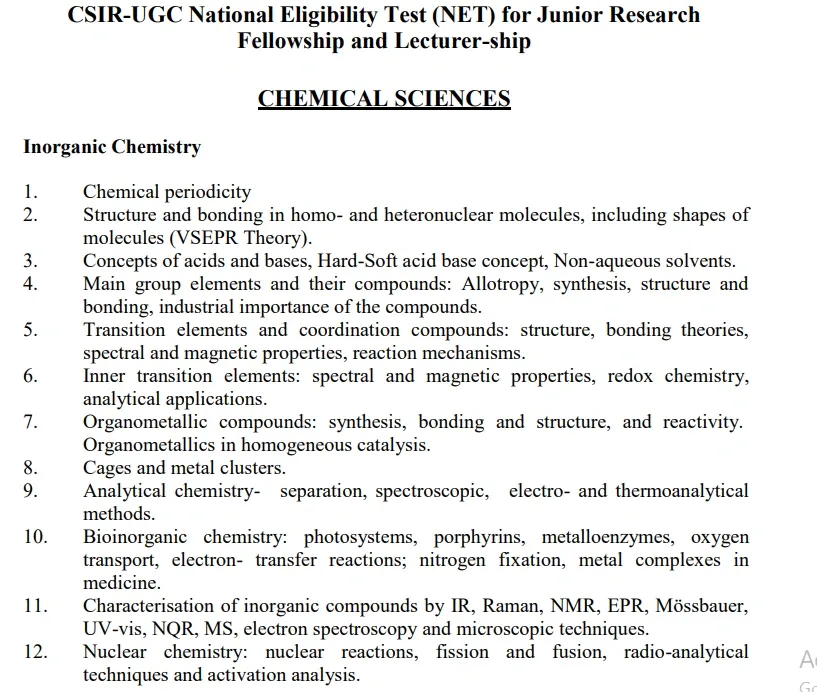
The CSIR NET Chemistry syllabus covers:
- Chemical periodicity
- Chemical bonding
- Acids and bases
- Main group chemistry
- Transition elements
- Coordination compounds
- Inner transition elements
- Organometallic chemistry
- Cages and metal clusters
- Analytical chemistry
- Bioinorganic chemistry
- Inorganic characterisation techniques
- Nuclear chemistry
Special attention should be given to coordination chemistry, organometallics, spectroscopy, bioinorganic chemistry and bonding, while continuing to cover the complete CSIR NET syllabus.
3. Choose Reference Texts Strategically
One of the biggest problems in CSIR NET Chemistry preparation is book overload. Candidates often collect multiple books for Organic, Inorganic and Physical Chemistry and then spend more time deciding what to read than actually studying.
You do not need to read every standard textbook to crack CSIR NET Exam 2026 with JRF. Rather use reference books to understand difficult concepts, not to replace your CSIR exam strategy.
However, there are standard CSIR NET reference texts such as Clayden for Organic Chemistry, J. D. Lee or Shriver and Atkins for Inorganic Chemistry, and Atkins for Physical Chemistry.
Useful CSIR NET Chemistry Reference Books
Organic Chemistry
- Organic Chemistry – Clayden, Greeves & Warren
Useful for:
- Reaction mechanisms
- Stereochemistry
- Organic transformations
- Synthetic reasoning
- Conceptual understanding
Inorganic Chemistry
- Concise Inorganic Chemistry – J. D. Lee
Useful for:
- Periodicity
- Main group chemistry
- Transition elements
- Coordination chemistry
- Inorganic concepts
- Inorganic Chemistry – Shriver & Atkins
Useful when you need deeper conceptual understanding of inorganic chemistry.
Physical Chemistry
- Physical Chemistry – Atkins, de Paula & Keeler
Useful for:
- Thermodynamics
- Quantum chemistry
- Statistical thermodynamics
- Electrochemistry
- Kinetics
- Molecular science concepts
Other CSIR NET Chemistry standard texts can be used selectively according to the topic and your existing academic background and to develop the level of understanding needed to solve CSIR NET questions.
4. Make Revision a Core Part of Your CSIR NET Preparation
Studying a topic once for the next CSIR NET 2026 does not mean you know it for the CSIR NET Chemistry exam 2026.
CSIR NET Chemistry 2026 requires candidates to retain a large amount of interconnected information:
- Reactions
- Reagents
- Mechanisms
- Exceptions
- Formulae
- Spectroscopic principles
- Coordination chemistry
- Group theory
- Named reactions
- Thermodynamic relationships
- Numerical methods
- Organic transformations
- Inorganic trends
This makes revision one of the five essential methods to crack CSIR , not something to be done only during the final week.
Try the 3-Level CSIR NET Revision Method
- Revision 1 - Concept Revision
- Revision 2 - PYQ Revision
- Revision 3 - CSIR NET Exam Revision
Use short notes, formula sheets, reaction maps and your error notebook. This is much more manageable than attempting to reread complete textbooks shortly before the upcoming CSIR NET Chemistry exam 2026.
5. Take CSIR NET Chemistry Mock Tests and Analyse Them
CSIR NET Chemistry Mock Tests should not be treated as a final CSIR NET preparation activity. Start attempting mock tests once you have sufficient CSIR NET syllabus coverage to make the analysis meaningful, and progressively move from topic tests, sectional tests to full-length mock tests.
What should you analyse after a mock test?
Instead of looking only at your CSIR NET mock test score, check the following things.
Area | What to Check |
Accuracy | How many answers were correct? |
Mistakes | Which questions were wrong? |
Concept gaps | Which topics do you not understand? |
Calculation errors | Where did you make avoidable mistakes? |
Time | Which questions consumed too much time? |
Guessing | Which answers were marked without sufficient confidence? |
Unattempted | Which questions could you have solved with better preparation? |
Maintain an Error Notebook
Maintaining an Error Notebook can become one of the most useful resources during the final weeks of your CSIR NET Chemistry Preparation 2026.
Divide it into:
- Concept Mistakes
- Calculation Mistakes
- Reaction/Mechanism Mistakes
- Memory-Based Errors
- Question-Reading Errors
- Time-Management Errors
Before every major CSIR NET Chemistry mock test, revise this notebook. The purpose of a mock test is not merely to produce a score, but to improve the next score.
How Dr Aparna’s 5 Methods Can Help You Qualify CSIR NET Chemistry 2026
These five preparation methods have been curated by Dr Aparna, PhD in Organic Chemistry, with a focus on making CSIR NET Chemistry preparation more structured, practical and exam-oriented. Her approach brings together PYQ practice, important-area analysis, standard reference texts, systematic revision and mock-test practice to help aspirants build stronger concepts and improve their performance.
For candidates targeting CSIR NET Chemical Sciences December 2026, this approach provides a clear preparation cycle, from understanding the syllabus and practising previous questions to revising concepts, testing performance and learning from mistakes. Used consistently, these methods can help you prepare with greater direction for CSIR NET JRF and Assistant Professor eligibility.
Free CSIR NET Chemistry Preparation Group
Preparing for CSIR NET Chemistry 2026 alone can make it difficult to know whether your strategy is actually working.
As part of the CSIR NET preparation support, candidates can use the Free learning groups by CC Learning App to discuss questions, preparation methods, important areas, revision strategies and examination updates with fellow aspirants.
Join the Free CSIR NET Chemistry Community
Free WhatsApp Group:
https://chat.whatsapp.com/Jn4GgRLs6zt1dmwzVZq82K
Also Read:
- CSIR NET Physical Science Admit Card 2026 Out | Download Hall Ticket @csirnet.nta.nic.in
- CSIR UGC NET Notification 2026 Out: Apply Online, Exam Date, Eligibility, Exam Pattern & Important Dates
- CSIR UGC NET Syllabus 2026 PDF Download: Subject-Wise Syllabus and Preparation
- CSIR NET 2026: Complete Guide to Eligibility, Exam Pattern, Syllabus & Application Process
- CSIR NET 2026 Eligibility Criteria: Age Limit, Qualification, & Category-wise Relaxation
- CSIR NET Exam Pattern 2026: Subject-wise Paper Pattern and Marking Scheme
- How to Apply for CSIR NET 2026? Step-by-Step Application Process & Registration Guide
Download CC Learning App and prepare for CSIR NET December 2026 with structured online coaching, expert guidance, practice and revision support!
Join Today!
Prepare for CSIR NET Chemistry With CC Learning App
A well organised CSIR NET Chemistry preparation platform can help when you need your classes, practice, revision and tests organised in one place.
With CC Learning App, a multi learning platform, candidates preparing for CSIR NET Chemical Sciences can build their preparation around the syllabus, strengthen Chemistry concepts, practise questions, revise systematically and test their progress.
If you are preparing for CSIR NET Chemistry December 2026, use the coming months to build consistency rather than waiting for the final phase. Start your CSIR NET Chemistry preparation with the best online NET coaching app in Kerala..
Download CC Learning App and prepare for CSIR NET December 2026 with structured online coaching, expert guidance, practice and revision support.
CSIR NET Chemistry December 2026 Frequently Asked Questions
How can I crack CSIR NET Chemistry in 2026?
Start with the official CSIR NET Chemical Sciences syllabus, build strong concepts in Organic, Inorganic and Physical Chemistry, solve previous year questions, identify high-priority areas, revise repeatedly and take regular mock tests. The most effective preparation is a cycle of concept learning, PYQ practice, revision, testing and analysis.
Which is the best way to prepare for CSIR NET Chemical Sciences?
There is no single method that works for every candidate. A structured combination of syllabus-based study, CSIR NET Chemistry PYQs, standard reference books, short-note revision and mock-test analysis is a practical approach.
How many years of PYQs should I solve for CSIR NET Chemistry?
For a serious December 2026 preparation plan, working through 2016–2026 PYQs can provide a substantial question bank and help you observe changes in question style and recurring concepts. The more important part is analysing the questions rather than simply counting how many you solved.
Which topics are important for CSIR NET Chemistry Exam 2026?
Important areas include coordination chemistry, organometallic chemistry, spectroscopy, quantum chemistry, thermodynamics, electrochemistry, chemical kinetics, stereochemistry, reaction mechanisms, named reactions, pericyclic reactions and organic spectroscopy. However, candidates should use these as priority areas while continuing to cover the complete syllabus. Recent preparation analyses also identify several of these areas as repeatedly tested.
Which books are best for CSIR NET Chemical Sciences 2026?
Commonly recommended standard references include Clayden, Greeves & Warren for Organic Chemistry; J. D. Lee and Shriver & Atkins for Inorganic Chemistry; and Atkins, de Paula & Keeler for Physical Chemistry. Choose books according to the concepts you need to strengthen rather than trying to read multiple books cover to cover.
How should I revise for CSIR NET Chemistry 2026?
Prepare concise notes containing formulas, reactions, mechanisms, important concepts, exceptions and mistakes from PYQs and mock tests. Revise these repeatedly instead of attempting to reread entire textbooks before the examination.
Notifications
Trending Updates


Related Blogs
June 19, 2026
CSIR NET 2026 Eligibility Criteria: Age Limit, Qualification, & Category-wise Relaxation
7 minute read
June 19, 2026
CSIR NET 2026: Complete Guide to Eligibility, Exam Pattern, Syllabus & Application Process
9 minute read
June 20, 2026