
Table of Contents
The KTET Category 2 examination is becoming increasingly competitive as more candidates apply for Upper Primary teacher posts in Kerala schools every year. Aspirants preparing for the Kerala Teacher Eligibility Test should understand the latest KTET Category 2 syllabus 2026, exam pattern, subject-wise topics, marks distribution and pedagogy sections before starting their preparation. Below is the detailed KTET Category 2 syllabus 2026, updated exam pattern and important subjects for effective exam preparation.
KTET Category 2 Exam Details
The Kerala Teacher Eligibility Test (KTET) category 2 is conducted by Kerala Pareeksha Bhavan for candidates aspiring to become upper primary teachers in Kerala government and aided schools. The K TET 2 is a mandatory qualification for candidates who wish to teach classes 6 to 8 across the state. As per the latest KTET category 2 eligibility criteria, applicants must possess a bachelor's Degree along with recognised teacher education qualifications such as B.Ed., D.El.Ed., B.El.Ed. or other approved equivalent qualifications. According to the latest KTET category 2 exam pattern, the examination is conducted in offline OMR mode with objective-type questions.
KTET Category 2 Syllabus PDF
The KTET Category 2 syllabus PDF gives candidates a clear understanding of the subjects, important topics, marks distribution and pedagogy concepts included in the Kerala Teacher Eligibility Test. It helps aspirants understand the exam pattern, question structure and overall difficulty level before starting their preparation. The latest KTET Category 2 syllabus 2026 includes subjects such as Child Development & Pedagogy, Language 1, Language 2, Mathematics & Science and Social Science. Candidates who prepare using KTET syllabus PDF can organise their preparation more effectively and focus on important areas with better clarity. Scroll down to check the complete subject-wise KTET category 2 syllabus 2026 and exam pattern details.
Enrol Now on Kerala TET Category 2 Coaching!
Join Today
KTET Category 2 Child Development & Pedagogy
A. Child development ( Elementary Child) (15 Questions)
1. Concept of development and its relation with learning
Growth and Development - stages of development - Infancy, Child hood, Adolescence - Maturation - Relationship between development, Maturation and learning.
Principles of development of children
Major principles of growth and development - Implication of learning -
Influence of Heredity and Environment
Role of Heredity and Environment on the development of child -Teacher's role.
2. Socialization Process
Concept of Socialization - Social world and children: Role of family, peers, teachers in the process of socialization - pattern of social development - Erick Erikson's theory of psychosocial development.
3. Piaget, Kohlberg, Vygotsky - Constructs and Critical Perspectives
Cognitive development theory of Piaget, Kohlberg's theory of moral development - Vygotsky's theory of social constructivism - Educational Implications.
4. Concept of child centered and progressive Education.
Concept of child centeredness - Individual difference - Methods of teaching and learning - Activity methods - Concept of progressive education - Role of teacher.
5. Critical perspective of the construct of Intelligence
Concept of Intelligence - Theories of intelligence - factor theories - S -I model of Intellect - multiple Intelligences - Concept of I Q - Intelligence Tests (Examples) - Sternberg's Information processing theory.
6. Language and Thought
Language development - stages, Theories - Piaget, Vygotsky, Chomsky - relationship between language and thought - approaches to language learning and teaching.
7. Gender as a social construct
Gender Roles, bias, educational practices - Gender equality - teacher's role.
8. Individual difference among learners
Understanding differences based on diversity of language, caste, gender, community, religion etc. Individual difference - socio cultural determinants
9. Continuous and Comprehensive Evaluation
( C C E) Concept - Assessment to learning - strategies - Cumulative records, Anecdotal records, Portfolios Assessment Techniques. - Feed back
10. Nature of prior learning
Readiness for learning - Strategies for assessment - Encouraging critical thinking - Teacher's role.
B. Inclusive Education (5 Questions)
Addressing learners from diverse back grounds - including disadvantaged and deprived. LD, MR, O P H, Sensorily deprived - socially and culturally deprived - Educational Implications/ Addressing the needs of LD. Exceptional children - Gifted, creative, specially abled children - Educational provision - Needs - characteristics - Identification and Remedial measures
C. Learning and Pedagogy (10 Questions)
Identification of individual learner needs - Intellectual, Emotional, Social, Creative needs, Catering to the individual needs of learners.
1. Process of teaching and learning -
Creating Learning situations - criteria of learning experiences - different modes of learning - social learning (Bandura) - co-operative and collaborative learning, Group discussion - Role of Teacher.
2. Cognitive Process and Emotions
Perception - concept formation - thinking - Imagination - Reasoning - Inductive and deductive - Problem solving - Memory - Emotional development - characteristics, Emotional maturity Emotional Intelligence - Emotional Quittance (EQ)
3. Motivation and Learning
Learning - Factors affecting Learning - Theories of Learning - Pavlov, Thorndike, Skinner, Gagne’s hierarchy of learning, Insightful learning (Kohler) - Constructivism - Piaget, Bruner, Vygotsky, Ausubel - Educational Implications
Motivation - Concept, types - Importance to learning - Theories of motivation - Abraham Maslow, Mc Clelland
4. Personality and adjustment
Concept - Approaches - Type, Trait - Allport - Measurement of personality - Projective and Non projective techniques - Adjustment Mechanisms
Begin Your Kerala TET Category 2 Journey with CC Learning App!
Join Now
KTET Category 2 Language 1 - Malayalam / English / Tamil / Kannada
A. Malayalam - 30 Questions
1. അവധാരണം (ഗദ്യം) (അഞ്ച് ബഹു വികല്പചോദ്യങ്ങൾക്ക് 5 മാർക്ക്)
- കേന്ദ്രാശയം കണ്ടെത്തൽ
- വിശകലനം
- നിഗമന രൂപീകരണം
2. അവതരണം (പദ്യം) (അഞ്ച് ബഹു വികല്പചോദ്യങ്ങൾക്ക് 5 മാർക്ക്)
- കേന്ദ്രാശയം കണ്ടെത്തൽ
- അർത്ഥ സാധ്യതകൾ കണ്ടെത്തൽ
- വ്യാഖ്യാനം
3. മാതൃഭാഷ ബോധനശാസ്ത്രം (6-8) (പത്ത് ബഹു വികല്പചോദ്യങ്ങൾക്ക് 10 മാർക്ക്)
- ഭാഷാപഠനം സംബന്ധിച്ച സിദ്ധാന്തങ്ങൾ
- വ്യത്യസ്ത കഴിവുള്ള കുട്ടികൾക്ക് പ്രത്യേക പരിഗണന നൽകൽ
- പാഠ്യപദ്ധതി വിനിമയത്തിന്റെ രീതിശാസ്ത്രം
4. ഭാഷ, സാഹിത്യം, സംസ്കാരം (പത്ത് ബഹു വികല്പചോദ്യങ്ങൾക്ക് 10 മാർക്ക്)
- ശൈലികളും പ്രയോഗങ്ങളും
- പ്രായോഗിക വ്യാകരണം
- പഴഞ്ചൊല്ലുകൾ
- സാഹിത്യത്തിലെ നൂതന പ്രവണതകൾ
- കാവ്യശാസ്ത്രം
- താളബോധം
B. English - 30 Questions
A. Language Comprehension (15 Questions)
- An unfamiliar passage or poem with questions on reading comprehension, inference, vocabulary and language elements.
- Questions to evaluate the knowledge of basic grammar such as Tense forms, Articles, Prepositions and Linkers.
B. Pedagogy of Language Development (15 Questions)
- Language Acquisition and Learning - Theories and their classroom implications.
- Principles of Language Teaching
- Language skills - Strategies to develop them
- Problems and challenges in language classrooms
- Teaching learning materials - Textbook, ICT and other teaching aids.
- Learner Assessment - Self, Peer, Teacher
- Strategies for teaching children with special needs (CWSN)
- Teacher Attitude and Aptitude
C. Tamil - 30 Questions
1. Reading Comprehension - Prose (5 Questions)
- Comprehension of theme
- Interpretation
- Inference
2. Reading Comprehension - Poem (5 Questions)
- Poetic images
- Comprehension of themes
- Interpretation
- Extended Meaning
3. Pedagogical aspects of Mothertongue education (10 Questions)
- Principles of Language Learning
- Inclusion of differently abled children
- Methodology of curriculum Transaction
4. Language, literature and culture (10 Questions)
- Books and Authors
- Functional Grammar
- Proverbs
- Trends in Literature
- Foreign Contribution in Tamil Literature
- Tamil Festivals and Folk Arts
D. Kannada - 30 Questions
1. Reading comprehension - Prose (5 Questions)
- Comprehension of Theme
- Interpretation
- Inference
2. Reading comprehension - Poem (5 Questions)
- Comprehension of Theme
- Poetic images
- Poetic emotions and feelings
- Imaginating elements
3. Pedagogical aspects of Kannada Language (10 Questions)
- Principles of Language learning
- Classroom Practices
- Inclusion of differently abled children
- Methodology of curriculum transaction
4. History of Language, Literature and Culture (10 Questions)
- Idioms, Phrases and usages
- Functional grammar
- Proverbs
- Rhythms
- History and Forms of Literature
Achieve Your Teaching Dream with KTET Category 2 Coaching!
Tap Here
KTET Category 2 Language 2 - Malayalam / English / Hindi / Arabic / Urdu / Sanskrit
A. Malayalam - 30 Questions
1. അവധാരണം (ഗദ്യം) (അഞ്ച് ബഹു വികല്പചോദ്യങ്ങൾക്ക് 5 മാർക്ക്)
- കേന്ദ്രാശയം കണ്ടെത്തൽ
- വിശകലനം
- നിഗമന രൂപീകരണം
2. അവതരണം (പദ്യം) (അഞ്ച് ബഹു വികല്പചോദ്യങ്ങൾക്ക് 5 മാർക്ക്)
- കാവ്യബിംബങ്ങൾ കണ്ടെത്തൽ
- കേന്ദ്രാശയം കണ്ടെത്തൽ
- വ്യാഖ്യാനിക്കൽ
- അർത്ഥതലങ്ങൾ കണ്ടെത്തൽ
3. ഭാഷാ പഠനത്തിന്റെ ബോധനശാസ്ത്രം (പത്ത് ബഹു വികല്പചോദ്യങ്ങൾക്ക് 10 മാർക്ക്)
- ഭാഷാപഠന സിദ്ധാന്തങ്ങൾ
- വ്യത്യസ്ത കഴിവുള്ള കുട്ടികൾക്ക് പ്രത്യേക പരിഗണന നൽകൽ
- പാഠ്യപദ്ധതി വിനിമയത്തിന്റെ രീതിശാസ്ത്രം
4. ഭാഷ, സാഹിത്യം, സംസ്കാരം (പത്ത് ബഹു വികല്പചോദ്യങ്ങൾക്ക് 10 മാർക്ക്)
- ശൈലികളും പ്രയോഗങ്ങളും
- പ്രായോഗിക കാരണങ്ങൾ
- പഴഞ്ചൊല്ലുകൾ
- സാഹിത്യരൂപങ്ങൾ
- കാവ്യശാസ്ത്രം
- താളബോധം
B. English - 30 Questions
A. Language Comprehension (15 Questions)
- One or two unfamiliar passages or poems with questions on comprehension, inference, vocabulary and elements of grammar.
- A few questions to evaluate knowledge of basic grammar, such as
- Article
- Concord
- Question tags
- Prepositions
- Tense and time
- Modal Auxiliaries
- Phrasal verbs and idioms
- Degrees of comparison
- Active and passive voice
- Reported speech
- Language functions
- Error identification
B. Pedagogy of Language Development (15 Questions)
- Language Acquisition and Learning - Theories and their classroom implications.
- Principles of Language Teaching
- Problems and challenges in the language classrooms
- Language skills - strategies to develop them
- Teaching learning materials - Textbook, ICT and other teaching aids.
- Assessment - Self, Peer, Teacher
- Strategies for teaching children with special needs (CWSN)
C. Hindi - 30 Questions
A. Pedagogy of language development (15 Questions)
- Concepts and process in language learning and acquisition.
- Developments - principles of language teaching.
- Role of listening and speaking.
- Functions of language and how children use it as a tool in formal and informal situations.
- Role of grammar in learning language for communicating ideas verbally and in written forms critical perspective.
- Challenges in language teaching.
- Diverse classroom - errors and disorders.
- Language skills.
- Evaluation in language learning-comprehension and proficiency.
- Teaching-learning material-other resource materials to be used in class rooms.
- Remedial measures to be taken in language class.
- Creating proper interactive situations in language class rooms.
- Competence of a teacher in selecting proper extended materials in language class rooms. Various forms of presentation of discourses in language class rooms.
- How to address the special needs of differently abled children in language class rooms.
B. Questions for Language comprehension (15 Questions)
- Reading unseen passages (prose, poem) and elements of language
- Division of Questions
- Question from Poem (5 Questions)
- Question from Prose (6 Questions)
- Question from Language Elements (4 Questions)
(Translation, technical terms, history of language, language elements)
- Question to be asked on the basis of the poem given to test the competence to comprehend ideas and enjoy the poetic emotions and feelings, imaginative elements, ideas and views beyond the lines, particular forms of composition, etc.
- Questions on the given prose or drama to test the competencey for comprehension, interpretation and language usage.
- Language elements like the structure of sentences, the combination of words, the usage of words in various situations, idioms in use and basic grammar.
- History & Culture of Languages - Major landmarks - developments of modern prose (Discourses)
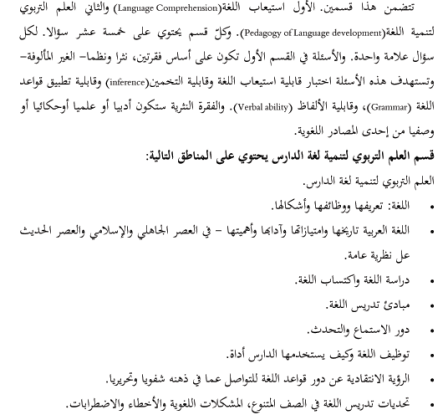
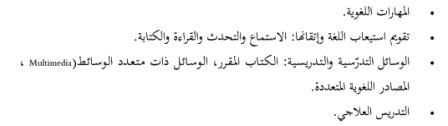
D. Arabic - 30 Questions
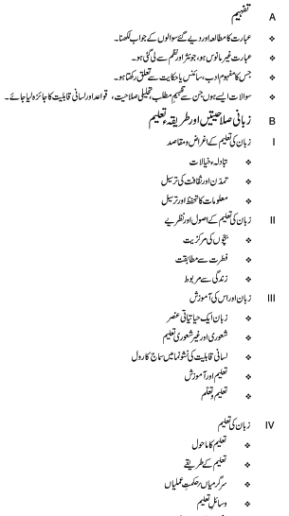
E. Urdu - 30 Questions
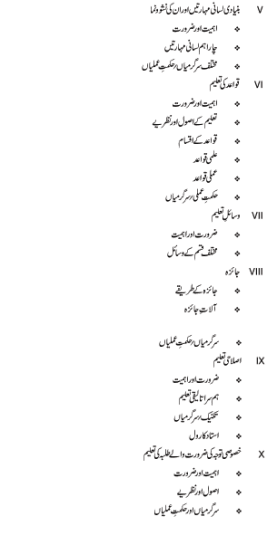
F. Sanskrit - 30 Questions
(A) Language Comprehension - 15 Questions
- अदृष्टं गद्यभागं/नाटकं पठित्वा तद्गतप्रश्नानानामुत्तराणामङ्कनम्। बहुविकल्पमातृकाप्रश्नाः षट्। पदम्, आशयः, सन्धिः, समासः, धातुः, लकारः, कारकम्, प्रयोगः।
- अदृष्टं श्लोकं/सुभाषितं पठित्वा तद्गतप्रश्नानाम् उत्तराङ्कनम्। बहुविकल्पमातृकाप्रश्नाः पञ्च। पदम्, आशयः, वृत्तम्, अलङ्कारः, सन्धिः, समासः।
- संस्कृतशास्त्र/ साहित्यसम्बन्धि सामान्यज्ञानम्। चत्वारः प्रश्नानां.
(B) Pedagogy of Language Development - 15 Questions
- भाषावगमः। (Learning and acquisition)
- भाषाबोधनतत्त्वानि। (Principles of Language teaching)
- भाषाधर्माः तेषां छात्राणां उपयोगिता च। (Role of listening and speaking, function of language and how children use it as a tool)
- मौखिकरीत्या वाचिकरीत्या च आशयविनिमयार्थं व्याकरणाध्ययनस्यावश्यकता। (Critical perspective on the role of grammer in learning a language for communicating ideas verbally and in written form)
- भाषाध्यापनसमस्याः। (Challenges of teaching language in diverse classrooms - language difficulties, errors and disorders)
- संकलितशिक्षा। (Inclusive education)
- भाषानैपुण्यः। (Language skills)
- भाषावगमस्य भाषानैपुणीनां च मूल्याङ्कनं - श्रवणम्, भाषणम्, वाचनम्, लेखनम् । (Evaluating language comprehension and proficiency - speaking, listening, reading and writing)
- पठनोपकरणाणि - पाठ्यपुस्तकम्, नूतनसाङ्केतिकसामग्र्यः, बहुभाषायुक्तकक्ष्या। (Teaching learning materials - textbook, multi-media materials, multi lingual resources of the classroom)
- परिहारबोधनम्, (Remedial teaching)
Join the Best KTET Online Coaching Platform in Kerala for Category 2 Exam
Tap Here
KTET Category 2 Science & Mathematics
Science (30 Questions)
a) Content - (20 Questions)
- Germination of seed - Steps of seed germination, Plant adaptations, Pest-pest control, Chemical and biological pest control.
- Cell - Cell structure, Cell organelles, Tissue, Types of tissues, Organ system, Levels of organisation.
- Diseases - Micro organisms, Mode of disease transmission, Preventive measures.
- Pollution - Different types of pollution, Bio-degradable and non bio degradable pollutants, Plastic waste.
- Cardio vascular system - Heart -blood-lymph, Arteries- veins- capillaries, Cardio vascular diseases
- Cellular equilibrium - Osmosis-diffusion-active transport, Cellular equilibrium
- Excretion - Kidney-skin.
- Plant reproduction - Agents of pollination, Seed dispersal, Types of fruits.
- Animal nutrition - Human digestive system, Indigenous food, Food adulteration.
- Human nervous system - Brain-nervous disorders.
- Body structure - Human skeletal system, Joints, First aid.
- Agriculture - Hybrid varieties of plants, Crop rotation, Nitrogen fixation, Vegetative propagation- (budding, grafting, layering), Tissue culture, Plant nutrition, Chemical and bio fertilizers, Integrated farming, Pisciculture- sericulture- epiculture, Plant diseases-plant disease control measures, Agricultural garden- agricultural research institutes, Indegenous varieties of animals- hybrid varieties of animals, Taxonomy, Two kingdom and five kingdom classification, Binomial nomenclature.
- Ecosystem - Food chain- food web- positive and negative interactions.
- Bio diversity - Conservation of biodiversity, Biosphere reserve- national park- zoological park- gene bank, Endemic species, Hot spot- sustainable development.
- Transparent and opaque objects - Reflection of light - images-different types of mirrors. solar eclipse-lunar eclipse-orbit-satellite information technology, Image formation by spherical mirrors.
- Solar system - Sun, planets, satellites, asteroids, meteorites, comets, etc.
- Simple machines - Inclined plane-pulleys-lever-fulcrum-resistance-effort -application of simple machines-electromagnet
- Magnetism - Properties of magnet, applications, earth's magnetism
- Energy - Different forms of energy-fuels-conservation of energy-forms of fuels-potential energy- kinetic energy-evaporation of water-
- Thermal Expansion - Density - heat and change of state-sea breeze and land breeze-atmospheric pressure and its application-fluid pressure. temperature, thermometer
- Static Electricity - Frictional electricity, electroscope, earthing, lightning and lightning arresters, conductors and insulators.
- Sound - Production of sound-characteristics of sound, application of sound (sonar, ultra sound etc) propagation of sound - sound pollution-musical instruments.
- Motion - Different types of motion-uniform, non-uniform speed, velocity, acceleration, Newton's laws of motion-friction-advantages and disadvantages.
- Thermal conductivity - Radiation-applications of thermal insulators (flask, casseroles)
- Basic concepts of force - Types of force-inertia-relation between inertia and mass. Basic concepts of thrust and pressure-relationship between surface area and thrust. Atmospheric pressure - barometer
- Different types of mixtures - Methods of separation of pure substances-acids and bases and its characteristics, reaction with metals and carbonates. Neutralisation, PH
- Metals - Metals and its characteristics-prevention of corrosion.
- Cosmetics - Chemical reactions and its classification - Chemical reactions in day to day life-effect of chemical reactions on nature. Molecules and atoms- fundamental concepts-classification of matter-symbols of elements-properties of elements and matter-structure of atom-discovery-Dalton's concept- atom model-Bohr' model of atom-atomic number and mass number. Octet electronic configuration. Role of electrons in bonding- valency-ions - atomicity
B. Pedagogy (10 Questions)
- Approaches to the science curriculum-criticism of contemporary science education-Aims and objectives of science education-science literacy.
- Approaches of science education-taxonomy of science education.
- Knowledge domain
- Problem solving skills-creativity domain-attitudinal domain-application domain
- Scientific inquiry
- Pedagogic strategies-activity based - collaborative and cooperative learning.
- Significance of the history of science
- Significance of laboratory
- Evaluation, CCE, assessment of performance
- Scientific attitude
- Methods of science teaching
- Role of science teacher
- Teaching and learning aids
- Psychological basis of science learning
Mathematics (30 Questions)
The examination will be broadly based on the topics prescribed for classes 6 to 8 in the Kerala State syllabus for mathematics, but some problems may have links to extension of these concepts to the higher secondary stage. The details are given below:
1. Content
Arithmetic
- Fractions : Different forms of the same fraction and reduction to lowest terms. Operations on fractions. Representation of certain fractions as terminating decimals. Operations on such decimals. Percent : Concept of percent and its relation to fractions. Applications of percent in monetary transactions, such as interest (simple and compound), profit and loss, and discount.
- Average : Average as representative number of a group of numbers. Computation of average. Quick computation of the change in average when one number of the group is replaced by another. Average of combined groups
- Negative Numbers : Use of negative numbers in certain physical contexts such as temperature and scoring. Fundamental operations of negative numbers. Use of negative numbers in algebra. Exponentiation : Exponentiation as repeated multiplication. Positive integral powers. Multiplication and division of numbers expressed as powers. Meaning of negative powers and its use in simplification. Ratio and Proportion : Ratios for comparing two or more magnitudes using a common unit. Multiple interpretations of comparisons involving ratios. Uses of the idea in such contexts as comparing different types in a group, different ingredients in a mixture, monetary division, aspect ratio in geometry and so on. Proportion as change of quantities without changing the ratio. The idea of the constant of proportion. Inverse proportion as proportionality with the reciprocal. The equations y = kx and y = kx . Use of these ideas in physics, such as in elasticity, levers and gravitation.
- Time and Distance : The concept of average speed. Relation between time, distance and average speed. Finding average speed of trips done in two parts in various cases such as when the distance in both parts are equal and when the time for both parts are the same.
Algebra
Use of algebra to express unchanging relations between changing physical quantities. Algebraic expressions as shorthand for arithmetical operations on unspecified numbers. General properties of arithmetic operations, especially products of sums and differences as algebraic identities. Formulation and solution of a linear equation in one unknown, arising from certain physical and mathematical contexts.
Geometry
- Angles : Angle as measure of slant and as measure of spread. Degree measure of an angle by dividing a circle into 360 equal sectors. Perpendicularity relation between the four angles made by two intersecting lines.
- Parallel Lines : A pair of parallel lines as lines keeping the same distance throughout and as lines having the same slant with a third line. Characterization of a pair of parallel lines in terms of various pairs of angles from the eight angles made by intersection with a third line. Sum of angles of a triangle and polygons.
- Triangles : Area of a triangle in terms of base and height. Drawing triangles according to some specified measures. Cases where two different triangles are possible and no triangle is possible. The concept of congruency of triangles, Sufficient conditions for two triangles to be congruent, such as having lengths of all three sides equal, lengths of two sides and included angle equal, lengths of one side and the two angles on it equal. Various applications of these ideas such as in proving properties of parallelograms and isosceles triangles, drawing the perpendicular bisector of a line and bisector of an angle.
- Quadrilaterals : Classification of quadrilaterals as rectangle, square, parallelogram, rhombus, and trapezium and their various characterizations. Drawing these types of quadrilaterals of specified measures. Areas of various types of quadrilaterals.
- Solids : The idea of a rectangular prism. Its volume and surface area.
Statistics
- Graphical Representation : Representing numerical data as pictographs, bar graphs, multiple bar graphs, line graphs and pie charts. Drawing inferences from such graphs.
- Tabular Representation : Representing numerical data as a frequency table.
2. Pedagogy
Nature of Mathematics
- Abstraction, Understanding children’s thinking and reasoning.
- Language of Mathematics.
Place of Mathematics in Curriculum
- Aims and objectives of learning mathematics in primary classes -Values of mathematics learning.
- Correlation with other subjects, Lower primary and Upper primary Mathematics curriculum
Mathematics - Trends and Developments
- Historical development of mathematics
- History of great mathematicians and their contributions
Approach to Mathematics Learning
- Proper learning experiences keeping in mind the characteristics of children, his natural learning capacity and the learning process of the child.
- Theoretical base of learning mathematics
Learning of Mathematics - Strategies and Methods
- Learning strategies – Concept attainment, Process oriented approach, Projects, Seminars, Field trip, etc. Different teaching learning methods –Inductive and deductive method, Analytic and Synthetic method, Project Method, laboratory method. Planning of a lesson
Learning Materials in Mathematics
- Textbook and Handbooks, Information technology, Mathematics club, Mathematics laboratory, Mathematics fair, Mathematics library.
- Mathematics collection - collection of mathematical puzzles, riddles, etc.
Mathematics Learning - Evaluation
- Concept of continuous and comprehensive evaluation, Evaluation activities, Grading the performance and recording the results.
- Diagnosis,Remedial Teaching and Error Analysis.
Ask Your KTET Doubts Anytime with Expert Mentors!
Tap Here
KTET Category 2 Social Science
History (12 Questions)
- Stone age, beginning of agriculture
- Civilizations - Egypt, China, Mesopotamia, Harappa
- Industrial and agrarian revolutions, capitalism
- Socialism, labour movements and labour struggles
- Colonialism in India
- Struggles of peasants, workers, tribals, women, sepoys, poligars, rulers and chieftains
- Revolt of 1857
- Social reform movements of India
- Indian national movement and Gandhian era.
- Movements for social change, peasant struggles and national movements in modern Kerala
Geography (12 Questions)
- Planets and other heavenly bodies
- Size, shape, interior structure of the earth, seasons, temperature zones
- Latitude, longitude, longitude and time
- Map and its types, scale, topographical maps, globe
- Climate & weather, temperature, pressure, rainfall and winds
- India - Relief, climate, drainage, vegetation
- India - Resources, agriculture, industry, transport, population
- Kerala - Physiography, drainage, agriculture, transport, human life
- Environmental problems and conservative measures.
Economics (8 Questions)
- Economic growth, development and human development - concepts and trends
- Five Year Plans
- Agriculture, food security and poverty
- Traditional industries of Kerala
- Money and banking
- Demographic trends - India and Kerala
- Globalisation and India
Political Science (8 Questions)
- Democracy
- People and state Government
- Political parties - Types and functions
- Election process and the Role of Election Commission
- Local Self Governments
Social Science - Pedagogy (20 Questions)
- Nature, scope, importance and correlation
- National goals, aims & objectives of instruction
- Curriculum - trends, principles & orgnaisations
- Analysis and planning of instruction.
- Types of learners and requirements for learning
- Learning resources and co-curricular activities
- Purpose and modern trends of evaluation
- Methods, approaches & techniques of instruction
- Characteristics of modern instructional strategies
Improve Your KTET Preparation with Live Doubt Clearing!
Tap Here
KTET Category 2 Exam Pattern 2026
The K TET Category 2 exam pattern is designed for candidates who wish to become upper primary teachers for classes 6 to 8 in Kerala schools. The K TET exam consists of 150 multiple-choice questions (MCQs) to be completed within 2 hours 30 minutes. Each question carries 1 mark and there is no negative marking for incorrect answers or unanswered questions. Candidates preparing with the latest KTET Category 2 syllabus and quality KTET study materials can improve their preparation and scoring chances in the Kerala TET examination.
Sl. No | Subjects | Questions | Marks |
1 | Child Development & Pedagogy | 30 | 30 |
2 | Language 1 - Malayalam / English / Tamil / Kannada | 30 | 30 |
3 | Language 2 - Malayalam / English / Hindi / Arabic / Urdu / Sanskrit | 30 | 30 |
4 | Subject-Specific Paper
| 60 | 60 |
Total | 150 Questions | 150 Marks |
Start Your KTET Category 2 Preparation with CC Learning App
Dreaming of becoming an upper primary teacher in Kerala? Start your KTET category 2 preparation with CC Learning App by Competitive Cracker, the best KTET coaching app and multi-skill learning platform designed for serious aspirants across Kerala.
Get complete preparation support with expert mentorship, structured study plans and exam-focused learning designed to help you crack the Kerala Teacher Eligibility Test with confidence.
Why Choose CC Learning App for KTET Preparation?
- Live and recorded KTET classes through app
- Personal mentor support
- Pedagogy-focused learning sessions
- Daily study plans and revision guidance
- KTET previous year question discussions
- OMR mock tests with performance tracking
- Quick doubt-clearing support
- Subject-wise preparation classes
Don’t wait for the upcoming KTET exam notification to begin your preparation. Start early with the latest KTET category 2 syllabus, updated study materials, and consistent practice through the CC Learning App to improve your confidence and scoring performance in the next KTET examination.
Download CC Learning App & Start KTET Preparation Today!
Get Here
Frequently Asked Questions
1. What is the KTET Category 2 exam?
KTET Category 2 is the Kerala Teacher Eligibility Test conducted for candidates who wish to become Upper Primary teachers for Classes 6 to 8 in Kerala government and aided schools.
2. Who conducts the KTET Category 2 examination?
The KTET Category 2 examination is conducted by Kerala Pareeksha Bhavan.
3. What is the latest KTET Category 2 syllabus 2026?
The latest KTET Category 2 syllabus 2026 includes Child Development & Pedagogy, Language 1, Language 2, Mathematics & Science and Social Science subjects.
4. How many questions are asked in KTET Category 2?
The KTET Category 2 exam consists of 150 multiple-choice questions carrying a total of 150 marks.
5. What is the duration of the KTET Category 2 exam?
Candidates are given 2 hours and 30 minutes to complete the KTET Category 2 examination.
6. Is there negative marking in KTET Category 2?
No, there is no negative marking for incorrect answers or unanswered questions in the KTET Category 2 exam.
7. What is the mode of the KTET Category 2 examination?
The KTET Category 2 examination is conducted in offline OMR mode with objective-type questions.
8. What qualifications are required for KTET Category 2?
Candidates must possess a Bachelor’s Degree along with recognised teacher education qualifications such as B.Ed., D.El.Ed., B.El.Ed. or equivalent qualifications.
9. Where can I download the KTET Category 2 syllabus PDF?
Candidates can download the updated KTET Category 2 syllabus PDF from the official Kerala Pareeksha Bhavan website or trusted KTET preparation platforms.
10. Which is the best app for KTET Category 2 preparation?
CC Learning App by Competitive Cracker is a trusted KTET coaching app that provides live classes, mentor support, mock tests, revision sessions and subject-wise preparation for KTET aspirants across Kerala.
Notifications
Trending Updates


Related Blogs
May 30, 2026
KTET Complete Guide : Eligibility, Exam Pattern, Syllabus, Application Process, PYQs & Preparation Strategy
10 minute read
May 29, 2026
KTET Application Fee 2026: Category Wise Fee Structure, Payment Methods & Important Instructions
5 minute read
May 29, 2026
KTET Category 1 Syllabus 2026 PDF : Subjects, Marks & Exam Pattern
11 minute read
May 28, 2026
KTET 2026 Child Development & Pedagogy: 5-Step Strategy to Score High
8 minute read
May 28, 2026