Table of Contents
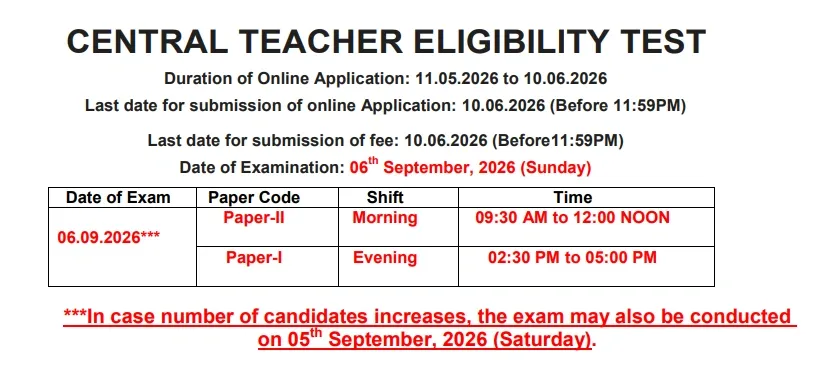
The CTET 30 Days Study Plan 2026 is designed for candidates preparing for CTET Paper 1 with limited time before the September 2026 examination. The upcoming CTET September 2026 exam is scheduled for September 6, 2026, according to the official CBSE information bulletin. The CTET 2026 30-day plan below combines Child Development & Pedagogy, Mathematics, Environmental Studies, English and Malayalam preparation with regular revision and practice.
CTET September 2026 Exam Date
The CTET September 2026 examination is scheduled for September 6, 2026 (Sunday). The official bulletin also states that if the number of candidates increases, the examination may additionally be conducted on September 5, 2026 (Saturday). Candidates should therefore follow the official CTET website for any further examination-related updates.
Why Follow a 30-Day CTET Study Plan 2026?
Following the 30-Day CTET Study Plan 2026 does not mean trying to study the entire CTET Syllabus randomly. A focused plan helps candidates divide the available time between Child Development & Pedagogy, Mathematics, Environmental Studies and Languages, while also leaving dedicated days for revision.
The biggest advantage of a 30-day CTET preparation strategy is that every subject receives regular attention. Instead of spending several days on one subject and neglecting another, candidates can study multiple sections each day and gradually build overall exam readiness.
This CTET Study Plan 2026 also includes revision days on Days 7, 14, 21, 28, 29 and 30, allowing candidates to revisit previously covered topics and identify areas that require additional practice.
CTET Exam Pattern 2026 for Paper 1
For CTET Paper 1, candidates should prepare across five sections in CTET Exam Pattern 2026.
Section | Questions | Marks |
Child Development & Pedagogy | 30 | 30 |
Mathematics | 30 | 30 |
Environmental Studies | 30 | 30 |
Language 1 | 30 | 30 |
Language 2 | 30 | 30 |
Total | 150 | 150 |
CTET 30 Day Study Plan 2026 for Paper 1
The CTET 2026 30-day timetable below is a preparation strategy, not an official CBSE study schedule. It has been curated by the experienced CTET faculties and mentors at CC Learning App, powered by Competitive Cracker, the best online CTET coaching app in Kerala.
Day | Subjects | Topic |
1 | English, EVS, Psychology, Maths, Malayalam | How to Read Passage; Food Part 1; Growth and Development; Numbers; സമാസം |
2 | English, Malayalam, Maths, Psychology, EVS | Learning and Acquisition Part 1; സമാസം കൂടുതൽ ചോദ്യങ്ങൾ, വിപരീതപദം; Division and Multiplication; Growth and Development; Food Part |
3 | English, Malayalam, EVS, Psychology, Maths | Children with Special Needs; പദശുദ്ധി; Simplification; Socialization; Cleaning of Food |
4 | English, Malayalam, Maths, Psychology, Science | Problems and Challenges in Language Classroom; Travel; Cognitive Development; Simplification; ശൈലികൾ Part 1 |
5 | English, Science, Psychology, Maths, Malayalam | ശൈലികൾ Part 2; General English Teaching Aids; Simplification; Cognitive Development; Family |
6 | Malayalam, English, Maths, Psychology, EVS | സമാനപദം 1; Principles of Language Teaching; Simplification; Intelligence; Family |
7 | — | Revision Day |
8 | Malayalam, English, Maths, Psychology, EVS | ശബ്ദം നാമം; Language Skills; Data Handling; Language and Thought; Water |
9 | Malayalam, English, Maths, Psychology, Science | ശബ്ദം നാമം; Language Skills; Data Handling; Individual Difference; World of Living Things |
10 | Malayalam, English, Maths, Psychology, Science | ദ്യോതകം; Methods and Approaches of Teaching Language; Data Handling; Language and Thought; Plants |
11 | Malayalam, English, Maths, Psychology, Science | Principle of Language Teaching; ബോധന ശാസ്ത്രം; Solids – SA, Cube, Cuboid, Cylinder; Flowering Plants; Gender and Social Construct |
12 | Malayalam, English, Maths, Psychology, Science | Role of Grammar in Teaching; ബോധന ശാസ്ത്രം; EVS Pedagogy; Learning Theory Part 1; Problems of Volume – Cylinder, Cone, Sphere |
13 | English, Malayalam, Maths, Science, Psychology | ഭാഷപഠനത്തിന്റെ ബോധന ശാസ്ത്രം; Linkers; Problems – SA of Cone, Sphere; Gender and Social Construct; EVS Pedagogy |
14 | Revision | Revision |
15 | English, Malayalam, Science, Psychology, Maths | Determiners; EVS Pedagogy; Learning Theory Part 1; ഭാഷപഠനത്തിന്റെ ബോധന ശാസ്ത്രം; Mathematical Operation |
16 | Malayalam, English, Maths, Psychology, Science | ഭാഷപഠനത്തിന്റെ ബോധന ശാസ്ത്രം; Measurement; Learning Theory Part 2; Determiners; Activities |
17 | English, Science, Psychology, Malayalam, Maths | Principles of Language Teaching; Activities; Field Theory; Bandura's Theory; ഭാഷപഠനത്തിന്റെ ബോധന ശാസ്ത്രം; Time |
18 | Malayalam, Maths, Psychology, English, Science | ഭാഷപഠനത്തിന്റെ ബോധന ശാസ്ത്രം; Money; Erikson's Psychological Development; Methods of Teaching Part 1; Animals |
19 | English, Science, Psychology, Malayalam, Maths | ഭാഷപഠനത്തിന്റെ ബോധന ശാസ്ത്രം; Patterns; Ausubel's Theory; Discovery Learning; Motions; Methods of Teaching Part 2 |
20 | Malayalam, Maths, Psychology, English, Science | ഭാഷപഠനത്തിന്റെ ബോധന ശാസ്ത്രം; Addressing Learning Difficulties; Units and Measurement; Abraham Maslow Hierarchy of Needs; Volume |
21 | Revision | Revision |
22 | Malayalam Pedagogy, Maths, Psychology, Science, English | ഭാഷപഠനത്തിന്റെ ബോധന ശാസ്ത്രം; Weight; CCE Assessment, Motivation, Evaluation; Pedagogy; Addressing Learning Difficulties |
23 | English, Science, Maths, Psychology, Malayalam | Teaching Composition; Force; NCF 2005; RTE Act; ഭാഷപഠനത്തിന്റെ ബോധന ശാസ്ത്രം; Weight |
24 | Malayalam Pedagogy, Maths, Psychology, Science, English | ഭാഷപഠനത്തിന്റെ ബോധന ശാസ്ത്രം; Micro Teaching; PWD Act; Force; Dealing with Language Disorders |
25 | English, Science, Psychology, Malayalam, Maths | Teaching Prose and Drama; Pedagogy CCE; Geometry; Learning and Pedagogy Part 1 |
26 | Malayalam Pedagogy, Maths, Psychology, Science, English | ഭാഷപഠനത്തിന്റെ ബോധന ശാസ്ത്രം; മൂല്യ നിർണയം; Geometry; Learning and Pedagogy Part 2; Acid and Alkali; Teaching Vocabulary |
27 | English, Science, Maths, Psychology | Activity Based Learning; Acid and Alkali; Developmental Theory – Kohlberg; Solids Around Us; ഭാഷാ അധ്യാപകൻ ക്രിയ ഗവേഷണം |
28 | Revision Day | Revision Day |
29 | Revision Day | Revision Day |
30 | Revision Day | Revision Day |
CTET 30 Day Study Plan PDF Download
Candidates can use this CTET 30 Days Study Plan 2026 PDF Download as a structured revision schedule covering Child Development & Pedagogy, Mathematics, Environmental Studies, English and Malayalam. The PDF can be saved for daily reference and used to track completed topics, revision days and practice sessions throughout the 30-day preparation period.
Click Here for CTET 30 Day Study Plan 2026 PDF Download
CTET Exam 2026 Important Tips for the Last 30 Days
- Complete the CTET syllabus before spending too much time on mock tests.
- Make short notes for Child Development & Pedagogy.
- Practice Mathematics daily.
- Solve comprehension passages regularly.
- Revise language pedagogy repeatedly.
- Keep an error notebook.
- Attempt previous year CTET question papers.
- Take full-length mock tests.
- Analyse every mock test.
- Reserve the final days mainly for revision.
- Follow official CBSE updates rather than relying on social-media rumours.
Start your final CTET September 2026 preparation today and use the remaining days strategically to qualify CTET in 30 days!
Enrol Today!
Can I Qualify CTET in 30 Days?
Yes, a 30-day CTET preparation window can be useful if you already have a basic understanding of the subjects and follow a disciplined strategy. However, there is no guaranteed shortcut to qualifying CTET 2026. Your CTET result 2026 will depend on your preparation level, accuracy, practice, revision and performance in the examination.
If you are starting from zero, use the first priority to complete the high-value concepts and then devote as much time as possible to question practice and revision.
Also Read:
- CTET Notification 2026 Released: Apply Online for September Exam @ ctet.nic.in
- CBSE CTET Eligibility 2026: Check Age Limit & Qualification
- CTET Paper 1 60 Day Study Plan 2026: Daily Timetable & Preparation Strategy
- CTET Exam 2026: Notification, Exam Date, Eligibility, Syllabus, Pattern, Result & Latest Updates
- Complete CTET Syllabus 2026 PDF for Paper 1 & 2 | Subject-wise Topics
- CTET Exam Pattern 2026 : Paper 1 & 2 Subjects, Marking Scheme & Duration
- CTET Notification 2026 Released: Apply Online for September Exam @ ctet.nic.in
- CTET Result 2026 Released – Check Your Scorecard, Qualifying Marks & Download PDF
Prepare for CTET 2026 with CC Learning App
Preparing for CTET 2026 with a proper study plan becomes easier when your CTET preparation, study materials, practice questions and mock tests are available in one place.
With the CC Learning App, a multi learning platform, candidates can prepare for CTET through structured learning resources, practice and revision support. Instead of studying randomly during the final 30 days, aspirants can follow a focused preparation routine and regularly evaluate their progress.
Start your final CTET September 2026 preparation today and use the remaining days strategically to qualify CTET in 30 days.
CTET 30 Days Study Plan 2026 Frequently Asked Questions
Can I qualify for the CTET in 30 days?
Yes, it is possible to prepare effectively in 30 days if you have a focused strategy, study consistently and give sufficient time to practice and revision. Candidates starting from scratch may need to devote more time each day.
What is the CTET September 2026 exam date?
The CTET September 2026 examination is scheduled for September 6, 2026 (Sunday). The official bulletin also mentions that September 5 may be used if the number of candidates increases.
Is 30 days enough for CTET Paper 1?
Thirty days can be sufficient for structured revision and focused preparation, particularly for candidates who already have familiarity with the syllabus. The key is to avoid spending too much time on one subject.
Which subject should I study first for CTET Paper 1?
Start with the subjects or topics in which your preparation is weakest while maintaining daily practice in Mathematics and Child Development & Pedagogy.
How should I prepare for CTET Child Development and Pedagogy in 30 days?
Focus on child development, learning theories, individual differences, inclusive education, assessment, learning difficulties and pedagogy-related concepts. Revise the theories repeatedly and practise application-based questions.
Notifications
Trending Updates