
Table of Contents
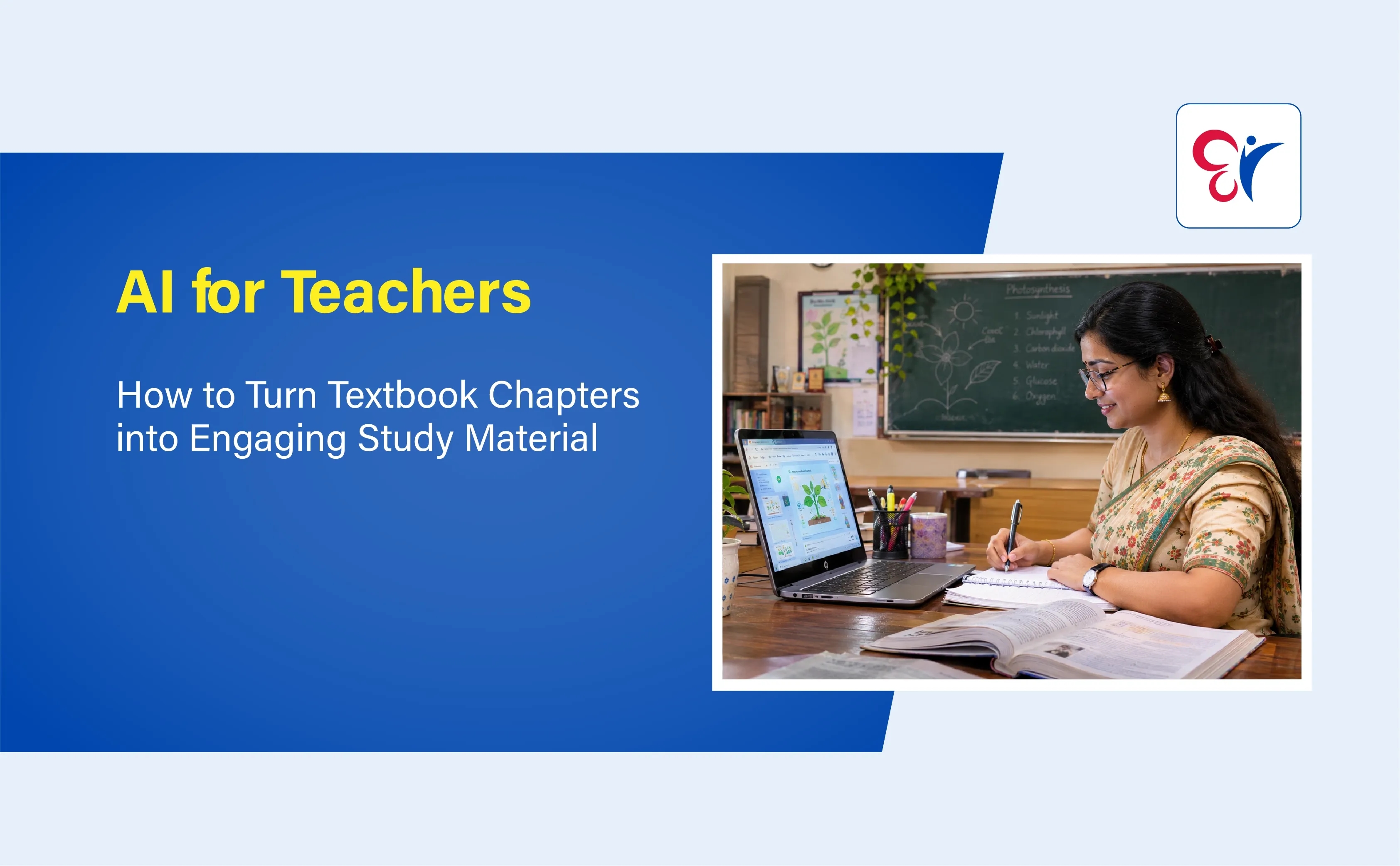
Teachers can use AI tools for teachers to simplify textbook chapters and create engaging study materials, including short notes, MCQs, worksheets, flashcards and interactive learning activities. For educators in Kerala, AI offers practical ways to develop supplementary resources based on SCERT and NCERT textbooks. Learn how AI in education can simplify lesson planning, save preparation time and make classroom learning more interactive, effective and student friendly.
What Is AI-Powered Study Material Creation?
AI-powered study material creation involves using artificial intelligence tools to transform existing educational content into different learning formats. Teachers can provide textbook chapters, lesson notes or selected text to an AI platform and request specific educational resources.
For example, a chapter about the human digestive system can be converted into:
- Simplified chapter notes and summaries.
- Important definitions and key points.
- Multiple-choice questions (MCQs).
- Fill-in-the-blanks exercises.
- Question-and-answer sets.
- Flashcards for quick revision.
- Classroom presentations.
- Worksheets and learning activities.
AI can organise information, simplify difficult explanations and suggest different ways to present a topic. However, teachers must verify the generated content before sharing it with students.
Want to Learn More About AI For Teacher Course by CC Learning App?
Click Here
Why Should Teachers Use AI to Create Study Materials?
AI tools for teachers can reduce repetitive preparation work and provide new ways to develop classroom resources.
1. Save Time on Lesson Preparation
Preparing separate notes, worksheets and question papers for every chapter can be time-consuming. AI can generate initial drafts of these resources, allowing teachers to spend more time reviewing content and interacting with students.
2. Simplify Difficult Textbook Chapters
AI can rewrite complicated textbook explanations using simple language. Teachers can use this feature to explain scientific terms, mathematical concepts and lengthy theoretical topics more clearly.
3. Create Different Learning Resources
Students have different learning preferences. Some understand concepts through reading, while others prefer diagrams, practice questions and interactive activities. AI helps teachers create multiple learning resources from a single chapter.
4. Support Personalised Learning
Teachers can use AI to develop basic, intermediate and advanced practice questions. This allows students to learn according to their understanding and academic requirements.
5. Prepare Assessments Quickly
AI can generate MCQs, short-answer questions, long-answer questions and revision tests from textbook content. Teachers can use these resources for classroom assessments and examination practice after checking their accuracy.
How to Convert Textbook Chapters into Study Materials Using AI?
Teachers can follow these practical steps to create AI-generated study materials from existing textbooks.
Step 1: Select the Textbook Chapter
Begin by selecting the chapter that requires additional learning resources. Teachers in Kerala can refer to prescribed SCERT or NCERT textbooks and identify lessons that need simplified explanations or revision materials.
Identify the class, subject, chapter name, important concepts and expected learning outcomes before using an AI tool.
Step 2: Upload or Enter the Textbook Content
Choose an AI tool that supports text instructions or document uploads. Depending on the platform, teachers can paste selected textbook content or upload a supported document.
Working with one chapter or a smaller section at a time makes it easier to review the generated information. Avoid uploading confidential student information.
Step 3: Generate Simple Chapter Notes
Ask the AI tool to convert the selected textbook content into organised study notes.
Example AI Prompt:
"Convert this Class 8 Science textbook chapter into simple study notes. Include important concepts, definitions, key points and examples. Use clear headings and bullet points. Maintain the original scientific meaning."
This helps teachers convert lengthy textbook explanations into easy-to-read revision notes.
Step 4: Create Important Questions and Answers
Question-based learning helps students recall information and understand important concepts.
Teachers can ask AI to prepare one-mark questions, short-answer questions, descriptive questions and application-based questions.
Example AI Prompt:
"Prepare 15 questions and answers from this textbook chapter for Class 9 students. Include five MCQs, five short-answer questions and five descriptive questions. Provide an answer key."
Teachers should verify the questions against the original textbook and prescribed syllabus.
Step 5: Prepare Flashcards for Quick Revision
Flashcards are useful for learning definitions, formulas, scientific terms and important concepts. For example, a biology chapter can be converted into question-and-answer flashcards covering cell structures, their functions and important biological processes.
Teachers can use these resources for classroom revision, group activities and independent learning.
Step 6: Create Worksheets and Classroom Activities
AI can help teachers develop worksheets that encourage active participation.
Some useful activities include:
- Match-the-following exercises.
- Fill-in-the-blanks questions.
- True or false statements.
- Word puzzles.
- Diagram-labelling activities.
- Group discussion topics.
- Practical learning exercises.
These activities encourage students to apply textbook knowledge rather than simply memorising information.
Step 7: Develop Visual Learning Resources
Teachers can use AI-supported platforms to create presentation outlines, diagrams, concept maps and visual explanations. For example, a history chapter can be converted into a timeline, while a science lesson can be explained using a labelled diagram or process flowchart.
Visual learning resources can make complex topics easier to understand and remember.
Step 8: Review and Finalise the Materials
AI-generated content is not always accurate. It may contain incorrect facts, incomplete explanations or information outside the prescribed syllabus.
Before using the materials, teachers should:
- Compare the content with the original textbook.
- Verify definitions, facts, dates and formulas.
- Check every question and answer.
- Remove irrelevant information.
- Ensure the language suits the students' academic level.
- Confirm that the material follows the prescribed syllabus.
Teacher supervision is essential for maintaining academic accuracy.
Best AI Tools for Teachers to Create Study Materials
Several AI-powered platforms can support different stages of educational content creation.
1. ChatGPT
ChatGPT helps teachers summarise textbook chapters, simplify explanations, generate MCQs, prepare worksheets and develop lesson plans.
2. Google Gemini
Google Gemini supports lesson planning, content development, explanations and educational resource creation. Available features may also help teachers develop study guides and revision materials.
3. Canva
Canva provides design tools for creating educational presentations, worksheets, infographics and classroom posters. Its AI-supported features can assist with visual content development.
4. Quizizz
Quizizz offers interactive quizzes and assessment tools. Teachers can use its available AI-supported features to develop questions and engaging classroom practice activities.
5. MagicSchool AI
MagicSchool AI provides education-focused tools for lesson planning, differentiated instruction, question generation and classroom resource development.
How AI Can Support Kerala School Teachers?
AI can help teachers in Kerala develop supplementary learning resources based on the prescribed school curriculum. The State Council of Educational Research and Training (SCERT), Kerala, plays an important role in curriculum development, textbook preparation and teacher support.
Teachers can use AI tools alongside SCERT and NCERT textbooks for the following purposes:
SCERT textbook notes: Simplify selected textbook chapters and prepare additional revision notes while retaining important concepts.
Malayalam and English learning materials: Develop explanations, vocabulary lists and practice questions in different languages. Translations should be checked for accuracy.
KTET and teaching examination resources: Prepare sample questions, teaching aptitude activities and subject-based revision materials.
Classroom worksheets: Create class-wise worksheets based on textbook chapters and learning objectives.
Digital learning resources: Develop presentation outlines, visual explanations and interactive activities for classroom teaching.
These applications can support teachers in government, aided and private schools across Kerala.
Practical AI Prompts Teachers Can Use
Clear instructions help teachers generate more relevant educational resources.
Requirement | Suggested AI Prompt |
Chapter summary | Summarise this chapter into simple notes for Class 7 students. |
MCQ preparation | Create 20 MCQs with four options and an answer key. |
Worksheet creation | Prepare a worksheet with matching, fill-in-the-blanks and short questions. |
Difficult concepts | Explain this topic in simple language with practical examples. |
Revision notes | Extract important definitions, formulas and key points. |
Lesson planning | Create a lesson plan with learning objectives and classroom activities. |
Personalised learning | Prepare basic, intermediate and advanced questions from this chapter. |
Important Things Teachers Should Consider Before Using AI
Although AI offers several advantages, teachers should use it responsibly.
- Check factual accuracy: Verify information using prescribed textbooks and reliable academic sources.
- Follow the syllabus: Ensure that generated materials cover the required learning objectives.
- Protect student information: Avoid uploading confidential student details to public AI platforms.
- Respect copyright: Follow applicable copyright requirements when adapting or distributing textbook content.
- Maintain teacher involvement: AI should support teaching decisions rather than replace professional judgement.
- Consider student requirements: Check whether the language, examples and activities are appropriate for the intended class.
Future of AI in Teaching and Learning
Artificial Intelligence is creating new opportunities in education and modern teaching practices. AI tools for teachers can simplify lesson planning, create engaging study materials and support personalized learning through interactive activities, revision notes and additional explanations. However, technology cannot replace teachers' subject knowledge, classroom interaction and guidance. Understanding how to use AI effectively is becoming an important skill for modern educators.
To help teachers develop these skills, the CC Learning App offers an AI for Teachers Course, designed to introduce educators to the practical applications of artificial intelligence in teaching. Teachers can explore how to use AI tools for lesson planning, educational content creation and engaging learning resource development. Enrol in the AI for Teachers Course on the CC Learning App and explore smarter ways to integrate AI into your teaching practices.
Download CC Learning App & Enrol AI For Teachers Course
Download Now
Frequently Asked Questions
1. How can teachers use AI to create study materials?
Teachers can use AI tools such as ChatGPT and Google Gemini to convert textbook content into notes, summaries, MCQs, worksheets, flashcards and question-and-answer sets.
2. Which is the best AI tool for teachers?
ChatGPT and Google Gemini are useful for generating educational content. Canva supports visual resource creation, while Quizizz helps teachers develop interactive quizzes.
3. Can AI convert textbook chapters into notes?
Yes. AI tools can summarise textbook chapters, simplify explanations and organise important concepts into structured revision notes.
4. Can teachers use AI to generate MCQs from textbooks?
Yes. Teachers can provide textbook content and request multiple-choice questions with options and answer keys. All questions should be checked before use.
5. How can AI help Kerala school teachers?
AI can support Kerala teachers in preparing supplementary SCERT and NCERT textbook notes, worksheets, question banks, classroom activities and Malayalam and English learning resources.
6. Are AI-generated study materials always accurate?
No. AI can produce incorrect or incomplete information. Teachers should verify all educational content using reliable textbooks and academic references.
7. Will AI replace teachers?
No. AI is a support tool that can simplify lesson preparation and content creation. Teachers remain essential for explaining concepts, guiding students and assessing academic progress.
Notifications
Trending Updates

Related Blogs
October 23, 2026
The Risks of Depending Too Much on AI for Teaching and Learning
9 minute read
October 12, 2026
AI for Teachers: Best AI Tools, How to Use Them & Benefits for Classroom Teaching
12 minute read
November 17, 2026
AI for Teachers: How to Create Quizzes, Worksheets and Assessments in Minutes
10 minute read
November 4, 2026